13 September 2010

Wikileaks Iraq: Bigger, Longer and Uncut

According to Newsweek, Wikileaks is at it again, reportedly collaborating with a London-based news organization to release another trove of classified documents, this time from the Iraq War. Sources claim that this collection is three times larger than the infamous "Afghan War Diary".

Detestable? Themistocles' Shade certainly thinks so, and I'm inclined to agree with him.

Yet, what's surprising about the Afghan War Diary wasn't so much what it revealed—little contained within the 70,000 documents came as a shock—but what they didn't reveal. For all of Bradley Manning's talk of uncovering "horrible war crimes", there were none to be found in Afghanistan. I suspect much will be the same with the Iraq War documents. Sure, some sources have claimed that the documents depict a "bloodbath" in Iraq, but that should be no surprise to those who paid attention to the war between 2004 and 2007.

There is, of course, the issue of revealing the identities of those who have worked with US forces during the course of the war. This was a very real concern in Afghanistan, though I doubt it would be as great an issue in Iraq. Insurgent groups such as al-Qaeda in Iraq (AQI) are broken, likely never to return in force. They have zero chance of usurping control of Iraq's government and instigating reprisals, as the Taliban could.

Which brings me to my question for the gallery: How badly have the Taliban been striking back at those who have worked with NATO in Afghanistan?

Update: The Pentagon scrambles to mitigate the damage from Wikileaks' latest salvo.

O! Say Can You See...

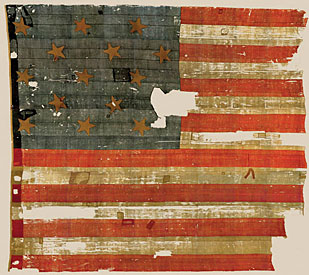
Thanks to Shaun Baker for reminding me that today is the anniversary of the bombardment of Fort McHenry in 1814.  The battle would be only a minor footnote in history, had it not been for a poem written on the morning of September 14th, "The Defence of Fort McHenry".  Set to the tune of a British drinking song, it became a rousing success.

Contemporary audiences, however, will recognize the song by its more common name, "The Star-Spangled Banner". 

Fun facts:

  • "The Star-Spangled Banner" was named the National Anthem of the United States in 1931.
  • The "Star-Spangled Banner" was sung before all major-league baseball games starting in World War Two.  However, it was frequently sung during the season openers and during the seventh-inning stretch as far back as 1897.
  • The flag which flew over Fort McHenry had fifteen stars and fifteen stripes.
  • 61% of Americans are unable to recall all the words to the first stanza of the song.
  • The "rockets' red glare" came from Congreve rockets fired by the HMS Erebus.  The "bombs bursting in air" came from the mortar ships HMS Terror, Volcano, Meteor, Devastation, and Aetna.  I only mention this because those are some pretty wicked ship names.  Too bad ancient Greek gods of darkness aren't influential members of Congress with control over defense spending. 

The Afghanistan Study Group--the MST3K version

I was about to read the Afghanistan Study Group's latest paper, when I realized it was universally panned by a number of foreign policy experts, most epically by Joshua Foust.

Maybe a group of bloggers should respond to the thing MST3K-style?  Who's with me?

Edit:  The Great Satan's Girlfriend tackled this subject far more sexifully than Joshua Foust.  That's right.  Far more sexifully.

12 September 2010

9/11/01

There's little I can say that hasn't already been said about September 11th.  With that said, please check out the words and images from those far more eloquent than I.


10 September 2010

US Army demonstrates LUH-72A Lakota in Germany

The Joint Multinational Readiness Center's website has the official press release for the Vienna Document demonstration of the Army's new LUH-72A Lakota.

Be sure to check out the article, as well as JMRC's excellent collection of LUH-72 pictures at Flickr.

Great advertising, DIA


During the last days of my Freshman year in Catholic school, I heard a peculiar announcement over the intercom during the morning announcements. Our head nun gave us a stern admonishment—do not bring squirt guns to class on the last day of school.

Bring squirt guns to school? What an incredible idea!

Inspired by the nuns' inadvertent reverse-psychology, I decided to bring my Super Soaker 50 to class on the last day, laying down a field of suppressive squirt gun fire upon unsuspecting classmates.

Would that the Defense Intelligence Agency have learned from my experience in Catholic school.

Last night, I received a few Tweets recommending a salacious new book, Operation Dark Heart, written by former Defense Intelligence Agency officer Anthony A. Shaffer.

What makes it so scandalous? Well, consider the fact that DIA officials identified over 200 breaches of security in the manuscript, even after the US Army had allegedly signed off on the book in January on the grounds that it had "no objection on legal or operational security grounds", according to the New York Times.

The DIA has scrambled to purchase 10,000 copies of the book in order to prevent them from hitting the open market. Yet, in the frenzy to snatch up the books before they hit the public, they've inadvertently given it a positive review from the New York Times—a boon to any publisher.

Even before the Able Danger imbroglio, Colonel Shaffer admits in his book, he was seen by some at D.I.A. as a risk-taking troublemaker. He describes participating in a midday raid on a telephone facility in Kabul to download the names and numbers of all the cellphone users in the country and proposing an intelligence operation to cross into Pakistan and spy on a Taliban headquarters. 

In much of the book, he portrays himself as a brash officer who sometimes ran into resistance from timid superiors. 
"A lot of folks at D.I.A. felt that Tony Shaffer thought he could do whatever the hell he wanted," Mr. Shaffer writes about himself. "They never understood that I was doing things that were so secret that only a few knew about them." 
The book includes some details that typically might be excised during a required security review, including the names of C.I.A. and N.S.A. officers in Afghanistan, casual references to "N.S.A.'s voice surveillance system," and American spying forays into Pakistan. 
Damn, this guy sounds like Daniel Craig's James Bond.


I doubt the DIA's efforts will be successful. They've piqued the public's curiosity, and electronic copies of the book could easily make their way onto the Internet. After all, after word of the infamous "Rolling Stan" article leaked to the press, it was distributed over the Internet, resulting in Gen. McChrystal dismissal days before the issue even hit the newsstands.

09 September 2010

Decentralized Leadership—Easier Said than Done


Colonel (Ret) Christopher Paparone penned an excellent op-ed in Small Wars Journal regarding leadership styles appropriate for "ill-structured" or "wicked" problems, such as our modern counterinsurgency campaigns, as opposed to "command", associated with "well-structured" problems.

The topic has been discussed in some detail, most notably in TRADOC's Pamphlet 525-5-500, " Commander's Appreciation and Campaign Design". However, this excerpt from Col. Parapone's article serves as an excellent primer. 


Command is something associated with speed of decision-making and the critical need to do something or not do something even if the commander is not sure his/her command is the right one. The sources of power for command are coercion and compliance. Command is autocratic (hierarchical and coercive) in that it requires obedience (in its ideal form, execution-without-question). 
Management (or what the US military terms ―administration) is associated with deliberate (note the meaning of the term when hyphenated: de-liberate) setting of rules, process engineering, and rationally-derived resource allocation decisions to handle tame (recurrent) problems that have been solved before. Key management values are bureaucratic and technocratic (technological). The source of power for management is regulated by legal-rational rules and procedures. 
Leadership is associated with wicked situations that make command and managerial technical rationality problematic. Whether the situation is diagnosed as critical, tame, or wicked should drive whether to exercise command, management or leadership (and as Grint concludes, the complexity of the situation may demand elements of all three—and it is an art form to properly blend them). The key source of power for leadership is democratic (heterarchical) in nature in that it comes from those who, through intuitive processes and emotional responses, choose to follow.

I'm enthusiastic, yet somewhat skeptical of calls for more decentralized leadership within the Army, such as those examined in the book " The Starfish and the Spider". For starters, modern technology has given us the ability to micromanage on an unprecedented scale. For example, the Army's new Digital Training Management System could theoretically allow senior leaders to examine the training records of platoons or even individual soldiers. There's also the issue of the Army's organizational culture. Leaders can often think "in their intellectual comfort zone", usually based on their experience at more junior grades. This can unintentionally result in micromanagement as well.


Finally, As the wars in Iraq and Afghanistan wind down, and the Army moves to a more stable garrison environment—filled with well-structured problems—it will be even more difficult to foster a culture of innovation and decentralization. We will have lost the ill-structured environment which allows "leadership", as defined by Col. Parapone, to flourish. 

How do we make true leadership—as opposed to command and management—a reality? 
 

Right-Click, Copy, Left-Click, Paste does not effective communications make


In the early 1990s, it was popular to look at new forms of information technology—particularly the Internet—and envision a utopian future.


Look at the future envisioned by Gene Roddenberry in Star Trek: The Next Generation. The USS Enterprise's sophisticated holodeck—an immersive, holographic, virtual reality environment—is used solely for educational purposes and for G-rated relaxation. Of course, the last two decades of experience with the Internet have made this a laughable proposition. Were such a device to exist, you can bet that Wesley Crusher would spend his formative years sneaking off to the holodeck to look at 3-d pornography. Likewise, the ship's computer is used only for technical and educational functions, not for mass-mailing pictures of cats, as we do today. Um, that is, people other than me, of course.


Though the future of information technology isn't entirely dystopian—few can doubt the impact of the Internet on our day-to-day communications—modern information technologies can reinforce poor communication habits.


This should, of course, come as no surprise to anyone who's been reading this blog in the past few months, particularly my emphasis on relying on PowerPoint as a communications tool. But bullet-point statements, a reliance on pictures instead of words, and an emphasis on cosmetic issues aren't the only barriers to effective communication. A more insidious issue is a reliance on the simple "copy-paste" features of most computer systems.


Admit it, you've probably done it.


It's a growing problem, not just in bureaucracies, but in the educational system as well—where students can easily "write" a paper in a few minutes (albeit with facepalmingly-hilarious results when they're finally caught). It can be used properly in certain contexts—certainly we've all done it—but it can have its abuses, as well.

A few all-too-common examples.


Army headquarters at the battalion and higher levels distribute operations orders, or "OPORDS", for tactical missions. Tracing their lineage back to the short, five-paragraph orders written by the Swedish king Gustavus Adolphus in the 17th Century, they have grown into a massive beast. In modern, "steady-state" operations in Iraq, Afghanistan, and even in home station, organizations disseminate information through a daily or weekly "fragmentary order". The FRAGO, as it's known, might contain anything from tactical directives to step-by-step instructions for ordering a burger at the local Burger King . (In a curious twist of doctrine, one might even find multiple operations orders embedded within the weekly FRAGO.)


Passed from headquarters to headquarters—from a division to a brigade to a battalion—it's subject to modification, certainly, but much relevant information is simply copied and pasted as it travels through the chain of command. In fact, FRAGOs often contain so much information (when compiled on a weekly basis, a brigade FRAGO can be hundreds of pages long) that overworked staffs must frantically copy-and-paste information in order to distribute the FRAGO to lower echelons before the information becomes obsolete.


In the rush, staffs often have little time to apply a critical eye to the FRAGO. Today, modern militaries produce and disseminate so much information that—in this officer's mind—many simply give up on trying to consume and comprehend it all.


While relying on copy/paste to transmit information is understandable—albeit regrettable—many more use modern technology to arbitrarily copy and paste information from PowerPoint slides or memoranda. It's relatively simple for a user to find a PowerPoint presentation or Word document with information generally related to their line of work. With judicious Copy/Paste and a few tweaks to a slide's background or a memo's heading, a user can often pass off such documents as his or her own work.


True comprehension of material, however, doesn't always follow.


I was once in charge of compiling submissions for a comprehensive battalion "standard operating procedures"—the book on how an organization does business. After receiving chapters on logistics, air mission planning, communications, administration and maintenance from the appropriate specialty officers, it became painfully obvious that many simply copied and pasted text lifted from other organizations.

How could I tell for certain? Well, when I asked for revisions, many seemed puzzled that they made such egregious mistakes in their "work".


How egregious? How about writing about the wrong types of helicopters? (There were several mentions of OH-58D helicopters, where "Find and replace" failed to properly change the reference to UH-60).


So what say ye? What's the worst use of copy/paste you've run across?


07 September 2010

A Blog Worth Following

Some recent graduates from the University of Illinois--and Army officers to boot--have started their own blog. It's definitely worth checking out.

The Lessons of a New Generation

As I've been catching up on the weekend's happenings—the non-LEGO Whorehouse related ones, that is—I've been struck the generational differences inherent in some recent posts from milbloggers like Commander Salamander, Gulliver at Ink Spots, Elizabeth Dickinson at Foreign Policy Online, and SWJ's Major Mike Few.

The experiences an officer gains during his or her first years in service—when our minds and mores are most malleable—will shape their worldview for the rest of their careers. As such, both of America's forays into Iraq—as well as other social and political phenomena—have shaped Gen Xers and Gen Yers in very different ways.

Commander Salamander reminds us that there are many events which define each generation of officers. The generation which lived through Vietnam was so haunted by Vietnam that they threw away much of the counterinsurgency doctrine, turning their attention instead to Air Land Battle. Subsequently, Gen Xers were defined by events such the First Gulf War, the end of the Cold War, Tailhook, and the military drawdown of the 1990s—possibly leading to a sense of military hubris, and a "do more with fewer troops" attitude.

We will always owe Gen Xers a debt of gratitude, for it was they who trampled Saddam's armies in the deserts of Iraq in a 96-hour blitzkrieg. Indeed, it was this generation's all-volunteer force, armed with sophisticated precision-guided weaponry, which returned home to victory parades, vindicating the specter of the Vietnam War. But in many ways, the relative ease of Desert Storm may have added to a sense of hubris; a belief that overwhelming military force—and precision fires in particular—could solve the world's ills.

With the wars in Afghanistan turning into decade-long endeavors, there is a sense of profound skepticism among the post-9/11 generation about the utility of force, for certain. But there's something else as well. Whereas those that lived through the Vietnam War harbored their resentment towards the civilian leadership, I think many of us feel the same way about both the military and civil leadership—at least during the first few years of the war.

What lessons will we carry forth?

06 September 2010

A Brigade’s Worth of Boogie-Woogie Bugle Boys?


Don't get me wrong; I'd like to consider myself a patron of the arts (particularly certain LEGO projects). However, if Secretary Gates is trying to trim some fat from the DoD's budget, he might want to consider that the US Army alone has slots for 4,600 band members, according to a recent article in the New York Times. That's more than an entire brigade combat team's worth of band members.


(According to doctrine manuals, a Stryker Brigade Combat Team should have approximately 3500 soldiers)
The surge strategy in Iraq of sending troops to distant outposts "left a lot of soldiers out there where there wasn't entertainment or morale-type things," he said. The increased use of helicopter transportation in such a conflict zone also argues in favor of smaller groups. The Army band world has adopted an informal motto, Colonel Palmatier said: "If it can't fit into two Blackhawks, it's not going to happen." (Blackhawk helicopters can generally hold 4 crew members and 14 troops.)
The high-profile, large-scale Army bands, of course, remain. Along with the Army Field Band, which tours heavily, they include the United States Army Band, informally known as "Pershing's Own" or not so informally as Tusab. There are also the United States Military Academy Band and the Old Guard Fife and Drum Corps. The Army has 30 more bands on active duty, as well as 70 Reserve and National Guard bands. All told, it has slots for 4,600 band members.


Army bands have plenty of company in the other services. The Navy has 13 bands; the Air Force maintains 12 active-duty bands, joined by 11 in the Air National Guard; the Marine Corps sponsors the United States Marine Band ("the President's Own") of White House renown, and a baker's dozen other active-duty bands.


[Army bands are divided] into categories: large, usually assigned to an Army command; medium, for the corps level; and small, for division headquarters or individual installations. The bigger the band, the more performance teams.

Note that this article only tackles "official" military bands. God only knows if they took into consideration organizations like the 82nd Airborne Division Chorus and other ensembles.


With a steady increase in the number of generals—a phenomenon Secretary Gates refers to as "brass creep"—comes a natural increase in the number of bands. And calls to reduce bands—however superfluous they might be—will be met with resistance. Consider that division-level bands—which typically cater to the vast majority of funerals and changes of command—are mirrored by even larger Corps- and Army-level bands.


Focus: What do you think? Are all the military bands worth it? What's the greatest performance you've ever seen from a military band?


Catching up

I have a lot to catch up on after this weekend, judginag by the 400 unread items in my Google Reader feed.  Lest anyone doubt my weekend absence was in vain, I give you pictures of a bona-fide LEGO Red Light District.


I wanted to proclaim my elation at this serendipitous discovery from the top of a mountain.  However, lacking a mountain, I decided to simply post a picture on Twitter.

JimmySky had the best response.

"Be careful.  This sounds like one of those square peg/round hole situations".

05 September 2010

So, this happened.

I must have set back our public diplomacy efforts by at least a century.  

01 September 2010

Naval Alliance FAIL

Journalist Carl Prine recently alerted me to the news that the British and French, due to budget constraints, will actually be pooling their aircraft carrier fleets.  Thus, Britain and France will be able to keep at least one of their three aircraft carriers--the HMS Ark Royal, the HMS Illustrious and the Charles De Gaulle--at sea at any one time.

I, for one, am a tad cynical.  The British and French navies are, quite possibly, the only navies that have done more harm to one another as allies than they have as enemies.  In 1940, the British sank an entire French fleet off the coast of Algeria, killing over 1200 French sailors, for fear that the Germans--having recently accepted the French surrender--might use the French battle fleet against them. (H/T Rex Brynen for the reference to that one)

Over forty years later, during the Falkland Islands War, the British fleet was menaced by a new sea-skimming anti-ship missile which crippled or sank a number of British warships, most notably the HMS Sheffield.  The new weapon, of course, was the Exocet missile, manufactured in France and sold to the Argentinians.

Horatio Nelson must be rolling in his grave cask of brandy.

Your PowerPoint Quote of the Day

The brass may not have approved of Col. Lawrence Sellin's now-infamous anti-PowerPoint rant, but legions of frustrated PowerPoint Rangers wholeheartedly agree.  Just check out these responses to Sellin's article. 

And note that these snarky sentiments are expressed in coherent words and sentences--the way they should be. 

(And more well-written than my post yesterday, that's for sure.  Thanks for the suggested revisions, guys!)

"Sadly, [Colonel Sellin] is right," wrote commenter Carl F. of Dallas. "The military has become so enamored with PowerPoint that it is rapidly losing track of its real mission and replacing it with a pablum-type spoon-fed mini-information series of slides that can't come close to truly clarifying muddy water, much less the war. Unfortunately, if today's military leaders were to put up against the Axis forces of [World War II], we'd all be speaking German or Japanese -- which we'd learn from them via PowerPoint."


Responding to Carl F., reader C.J. wrote: "I'm not so sure we'd be speaking German or Japanese at this point, but because the 'briefing' mentality is pretty cross-cultural, I'm more inclined to think we'd still be fighting some offshoot of the 18th and 19th century global colonial wars. Oh, wait..."