Congratulations to Laurenist for successfully deciphering precisely what event prompted me to Tweet "Facepalm" and to set my Facebook status to "FML".
Clearly, I have found the right medium.
30 September 2010
Reviews of Obama's Wars
Looks like Eliot Cohen (at the WaPo) and Max Boot (at the WSJ) have beaten me to the punch with reviews of Obama's Wars. Be sure to check them out.(H/T Tom Ricks and SWJ)
The best-kept secret in Washington?
Few outside the Beltway realize that the Great Satan's Girlfriend is an all-too-guilty pleasure for a surprising number of bored Washingtonians.
'Fess up.
29 September 2010
Updated Blogroll
Once again, it's time to update the blogroll:
- 6th Generation Warfare
- Father Muskrat
- @Laurenist
- Mother Jones (worth it for at least the "We're Still at War" picture, every day)
- The Fighting Illini
A-model woes
There's an old saying in the aviation community: "Never fly the A-model of anything".
Certainly, many military aircraft--even some of the best--have had poor debuts, with bugs not worked out during prototype testing making their way into full production. The P-51 Mustang, designed and built in less than four months, suffered from poor performance at high altitudes during its initial run. Only with the development of the P-51D Mustang--complete with a new engine, six .50-caliber machine guns, and a bubble-canopy (OODA Loop, anyone?)--did the P-51 come into its own, racking up an impressive kill ratio against even the formidable German Me-262 jet fighter.
The UH-60 also had a somewhat lackluster debut, with its automatic stabilator--a variable-geometry airfoil on the tail section of the aircraft--frequently failing, causing sudden and violent nose-dives. In fact, concerns over the stabilator's all-too-frequent uncommanded slewing caused pilots from the 82nd Airborne Division to fly with the stabilator slewed all the way up during their raid on Calivigny Barracks during the invasion of Grenada.
This, unfortunately, only complicated their problems, as the aircraft came in for landing with a far too nose-high attitude, leading to a crash of three Black Hawks in a landing zone surrounded by hundreds of Cuban and Grenadian troops.
Yet, the P-51 went on to become arguably one of the best propeller-driven fighter aircraft ever built; and the UH-60 has gone on to become one of the most successful military helicopter designs in the world. Which is why I hope that the recent troubles with the US Navy's new nuclear attack submarine, the Virginia-class, are just typical A-model woes:
And in other naval news, let's hope that the debut of Iran's latest "flying boat" turns out to be little more than A-model nonsense. According to the DEW Line, this is the most ridiculous naval design since the Soviet Union's ekranoplan, better known as the "Caspian Sea Monster".
Certainly, many military aircraft--even some of the best--have had poor debuts, with bugs not worked out during prototype testing making their way into full production. The P-51 Mustang, designed and built in less than four months, suffered from poor performance at high altitudes during its initial run. Only with the development of the P-51D Mustang--complete with a new engine, six .50-caliber machine guns, and a bubble-canopy (OODA Loop, anyone?)--did the P-51 come into its own, racking up an impressive kill ratio against even the formidable German Me-262 jet fighter.
The UH-60 also had a somewhat lackluster debut, with its automatic stabilator--a variable-geometry airfoil on the tail section of the aircraft--frequently failing, causing sudden and violent nose-dives. In fact, concerns over the stabilator's all-too-frequent uncommanded slewing caused pilots from the 82nd Airborne Division to fly with the stabilator slewed all the way up during their raid on Calivigny Barracks during the invasion of Grenada.
This, unfortunately, only complicated their problems, as the aircraft came in for landing with a far too nose-high attitude, leading to a crash of three Black Hawks in a landing zone surrounded by hundreds of Cuban and Grenadian troops.
Yet, the P-51 went on to become arguably one of the best propeller-driven fighter aircraft ever built; and the UH-60 has gone on to become one of the most successful military helicopter designs in the world. Which is why I hope that the recent troubles with the US Navy's new nuclear attack submarine, the Virginia-class, are just typical A-model woes:
Of all the complicated gadgets in the Pentagon's arsenal, a nuclear submarine is one that probably shouldn't be built on the cheap. Yet according to military analysts, that's precisely what the Navy and two defense contractors did with a series of $2 billion attack subs, and now they're literally dropping chunks of their protective skins into the briny deep.
The problem afflicts the Navy's growing fleet of Virginia-class subs, high-tech boats longer than a football field and armed with a dozen Tomahawk cruise missles. The subs are coated with a "special hull treatment," urethane tiles that are supposed to make them super-stealthy, reducing their noise underwater and absorbing sonar impulses. As these photographs show, and as the Pentagon's top weapons inspector has reported, the tiles have been peeling off of the subs while they're at sea, often in large sections. So far, missing tiles have been documented on four of the Navy's seven Virginia-class subs, the first of which launched in 2003.
The disappearing tiles won't sink the subs, but they could seriously impede their primary mission—to run silent and run deep without being detected. "When pieces of the hull coating fall off, the sub gets noisier because it interrupts the water flow over the hull," Norman Polmar, a defense analyst who literally wrote the book on Navy subs, explained to the Newport News, Virginia, Daily Press. "When you put more noise in the water, you're easier to detect." A blogger at Halibut Hangar, which discusses submarine systems, puts it more bluntly: "The submarine platform may purr like a kitten when delivered and roar like a lion after a subsystem failure."Maybe we should staff these subs with a crew of IDF Death Babe submariners. It may just happen, according to some reports.
And in other naval news, let's hope that the debut of Iran's latest "flying boat" turns out to be little more than A-model nonsense. According to the DEW Line, this is the most ridiculous naval design since the Soviet Union's ekranoplan, better known as the "Caspian Sea Monster".
28 September 2010
A critical issue
We can help prevent suicide. Maybe not all suicides, but we can at least curtail them if we work hard enough. I'm certain of it.
The US Army's Forces Command's (FORSCOM) Twitter feed had a few good links on the subject. Please read these articles and take them to heart. Share them with your friends.
Together, maybe we can help get this under control.
The US Army's Forces Command's (FORSCOM) Twitter feed had a few good links on the subject. Please read these articles and take them to heart. Share them with your friends.
Together, maybe we can help get this under control.
Deliberation

Suffice to say that Adam Weinstein of Mother Jones wasn’t too keen on the often-petty intrigue found in Robert Woodward’s latest book, Obama’s Wars. Yet, I think the disagreement and dissent within President Obama’s inner circle was, and still is, healthy. (Edit: So does Jamie McIntyre) After all, another Democratic president, also full of youth and new ideas, actually encouraged dissent during one of the world’s greatest crises: the Cuban Missile Crisis.
According to Robert F. Kennedy’s memoir, Thirteen Days, President John F. Kennedy encouraged disagreement and debate among his top advisors, dubbed the “Ex Comm”, during those dangerous days of October 1962. Then-Attorney General Robert Kennedy recalls that the President, faced with the very real possibility of nuclear war, solicited as many opinions as possible from his most trusted advisors. He valued this dialectic conversation so much that, upon learning of a plot by some advisors to exclude dissenters from a top-level meeting, President Kennedy intervened, allowing alternate viewpoints into the debate.
It’s worth noting that the most eerily prescient passage in Thirteen Days concerns Robert Kennedy’s frustration with the inability of generals to view the world in strategic terms. Kennedy’s military staff came up with plans for neutralizing the nuclear warheads in Cuba through airstrikes and/or a massive invasion. Yet, Robert Kennedy remarks that they couldn’t understand the greater strategic picture—action against Cuba might trigger a Soviet invasion of Europe (especially West Berlin), sparking a chain of events which could have easily led to nuclear war.
In many ways, President Obama is in a similar, though nowhere nearly as precarious, predicament. Certainly, ISAF can prevail in Afghanistan, given appropriate resources, as Aaron Ellis points out. Yet, the difficult decision is in weighing Afghanistan against the greater strategic picture. Not even America has unlimited resources to spare. Therefore, President Obama has realized that we need to balance the threat the Afghanistan/Pakistan region with threats from North Korea, from China, and even from rogue hackers.
Grand Strategy is about making the difficult decisions and picking the right battles, and applying the right resources. It’s not an easy decision, to be sure. I don’t envy the responsibility of President Kennedy during the Cuban Missile Crisis, nor do I envy the dilemma facing President Obama now.
27 September 2010
For your reading pleasure
As you know, I have an on-again-off-again relationship with Piers Macksey's "The War for America", a strategic history of the American Revolution written from the British point of view.
So when I found out that Dr. Jeremy Black, author of one of my favorite books on military history, has a great new lecture, entitled "Could the British have won the American War of Independence", I jumped with glee. Too bad I won't be able to attend the lecture, which takes place next week. Sorry, but I have Volksfest in Stuttgart to attend.
Nevertheless, I wonder whether the British would have won the war, given their commitment to contain Bourbon France and Spain. At any rate, I have to postpone that topic. I just received Robert Woodward's latest book, "Obama's Wars", on my Kindle. I have to read this. The American Revolution, unfortunately, is old news.
So when I found out that Dr. Jeremy Black, author of one of my favorite books on military history, has a great new lecture, entitled "Could the British have won the American War of Independence", I jumped with glee. Too bad I won't be able to attend the lecture, which takes place next week. Sorry, but I have Volksfest in Stuttgart to attend.
Nevertheless, I wonder whether the British would have won the war, given their commitment to contain Bourbon France and Spain. At any rate, I have to postpone that topic. I just received Robert Woodward's latest book, "Obama's Wars", on my Kindle. I have to read this. The American Revolution, unfortunately, is old news.
iInTheSky?
Recently, Lt. Gen. Mark Hertling of the US Army's Training and Doctrine Command (TRADOC) announced that the Army might begin issuing iPhones to privates in basic training. Loaded with educational applications covering everything from first aid to the Soldier's Creed, these devices might be more handy than even the ubiquitous "Blue Books" issued by every division.
A number of...seasoned...soldiers expressed their disapproval with this new-fangled technology. Yet, I'm here to tell you that today I personally witnessed the iPhone's big brother, the iPad, loaded with educational applications for the Raven Unmanned Aerial Vehicle, held in front of about a dozen soldiers in a cramped barracks room.
I applaud Lt. Gen. Hertling for choosing this "off the shelf" product for testing. Virtually every soldier in Iraq and Afghanistan has an iPod, or a Kindle, or an iPad. It's time the military accepts this fact and offers applications for these devices.
26 September 2010
Here we go again
While I don't disagree with an emphasis on "full-spectrum operations", this quote regarding the 82nd Airborne Division's recent exercise sounds too reminiscent of the post-Vietnam era.

Drained by grueling hearts-and-minds efforts in Iraq and Afghanistan, the military is refocusing on fighting and killing the enemy, not nation-building.
Writing recently in Foreign Affairs magazine, Defense Secretary Robert M. Gates said, "The United States is unlikely to repeat a mission on the scale of those in Afghanistan or Iraq anytime soon — that is, forced regime change followed by nation building under fire." Instead, U.S. forces will probably be called on to help other countries' armies defend themselves, particularly against terrorist attacks but also against conventional armies.
Lawrence J. Korb, a former assistant secretary of Defense who closely follows military planning, said flatly: "We aren't going to be doing counterinsurgency again. We're not that good at it." Many units' major combat skills are rusty because of the counterinsurgency focus, Korb said.Captain Picard, can I get a facepalm, please?

Who will kneel before Zod? The UN knows.
Having brokered peace between Israelis and Palestinians, British and Northern Irish, and Hutus and Tutsis, the UN now turns its attention to one of the world's most pressing issues:
Who will represent Earth, should we ever encounter an alien life form?
Superman 2 and Independence Day would imply that this responsibility falls to the President of the United States. However, reports indicate that the United Nations Office for Outer Space Affairs has taken matters into its own hands, selecting Malaysian astrophysicist Mazlan Othman for just such an occasion:
You'd better get practicing, Dr. Othman. Kneel before Zod!
Who will represent Earth, should we ever encounter an alien life form?
Superman 2 and Independence Day would imply that this responsibility falls to the President of the United States. However, reports indicate that the United Nations Office for Outer Space Affairs has taken matters into its own hands, selecting Malaysian astrophysicist Mazlan Othman for just such an occasion:
THE United Nations was set today to appoint an obscure Malaysian astrophysicist to act as Earth’s first contact for any aliens that may come visiting.
Mazlan Othman, the head of the UN's little-known Office for Outer Space Affairs (Unoosa), is to describe her potential new role next week at a scientific conference at the Royal Society’s Kavli conference centre in Buckinghamshire.
She is scheduled to tell delegates that the recent discovery of hundreds of planets around other stars has made the detection of extraterrestrial life more likely than ever before - and that means the UN must be ready to coordinate humanity’s response to any “first contact”.
You'd better get practicing, Dr. Othman. Kneel before Zod!
25 September 2010
Updates

Also, don't forget to check Tom Rick's The Best Defense next week, where I should offer a limited defense of General Douglas MacArthur, whom Ricks has deemed the "Worst American General". (By comparison, the second-worst general, according to Ricks, is none other than Benedict Arnold)
Lastly, I hope to get around to updating the blogroll this weekend, unless Oktoberfest Round Two interferes.
24 September 2010
Robotic Marine Mules: Do we need them?
The US Marine Corps is preparing to return to its amphibious roots, following nearly a decade of desert-bound counterinsurgency operations in Iraq and Afghanistan.
So, what do you think? Do we need to re-examine amphibious warfare in the 21st Century?
As such, Marine leaders, such as General James Amos have argued for big-budget weapons, such as a floating tank known as the Expeditionary Fighting Vehicle, already grossly over-budget, years behind schedule, and the subject of furious debate.
As Spencer Ackerman also notes, The Corps might also adopt a robotic baggage carrier known as a "mule", with a number of prototype devices already in testing. American infantrymen and Marines now carry more equipment for day-long patrols as their counterparts did for entire campaigns twenty years ago. After years of FOB-bound fighting, American forces now rely on massive contractor support for fuel, food, ammunition, and water. According to Herschel Smith of The Captain's Journal, amphibious Marine squads might even be issued tactical Reverse Osmosis Water Purification Units (ROWPUs) to purify drinking water during an expeditionary campaign.
As Spencer Ackerman also notes, The Corps might also adopt a robotic baggage carrier known as a "mule", with a number of prototype devices already in testing. American infantrymen and Marines now carry more equipment for day-long patrols as their counterparts did for entire campaigns twenty years ago. After years of FOB-bound fighting, American forces now rely on massive contractor support for fuel, food, ammunition, and water. According to Herschel Smith of The Captain's Journal, amphibious Marine squads might even be issued tactical Reverse Osmosis Water Purification Units (ROWPUs) to purify drinking water during an expeditionary campaign.
Yet, Smith asks if these sorts of improvements are really necessary:
Good grief. We’re complaining about the Marines becoming too heavy, while we plan to send them ashore in the extremely heavy Expeditionary Fighting Vehicles. The Navy wants to be relevant, and in lieu of close support for the Marines, they plan on never-to-be-used powerless and irrelevant littoral combat ships. We want to do massive amphibious assaults against unknown enemies, yet we plan to start from so far off shore that we’re vulnerable to missile fire for some twenty five miles or more.
We want to be self sufficient, and yet logistics controls us to the point that we are planning for reverse osmosis purification units. We want to be quick to get to shore, but we cast our lots with the EFV when a new fleet of helicopters would allow us fast transit to the shore (and further inland) and fast-roping would allow quick ingress to the battle space with light, fast and well trained troops.
But are our Marines well trained? From backpacking, hiking and camping, I and each of my four children know how to purify water from our surroundings. I and each of my four children know how to climb and rappel. I and each of my four children know how to make decisions on the fly, not waiting on specific commands but relying on broad mission goals to guide our actions. And only one among my four children is a Marine.
So, what do you think? Do we need to re-examine amphibious warfare in the 21st Century?
The luckiest 'Hawk crew alive
The crewmembers of these two MH-60R helicopters are lucky they didn't wind up taking a swim in Lake Tahoe.
A newspaper from San Diego has a few more details. Suffice to say, it's difficult to say what caused the abrupt yaw, or what the pilots were doing over Lake Tahoe. A military investigation is pending.
By the way, I agree with the lady filming the incident: I didn't think they could do this, either.
(H/T Nick Dubaz)
A newspaper from San Diego has a few more details. Suffice to say, it's difficult to say what caused the abrupt yaw, or what the pilots were doing over Lake Tahoe. A military investigation is pending.
By the way, I agree with the lady filming the incident: I didn't think they could do this, either.
(H/T Nick Dubaz)
23 September 2010
Science fiction is a reflection of the present...
...as I've said before, and I'll say again. (Along with the ever-awesome Adam Elkus, of course)
As evidence, I offer the season opening of Star Wars: Clone Wars, in which morally-ambiguous "contracted mercenary bounty hunters" serve as instructors for the valiant Clone Troopers.
Cyber-Security. What is it?
Yesterday's Wall Street Journal included a damning criticism on the state of America's cyber security. Yet, what's striking about the debate on cyber security curious lack of detail. Aside from vague promises to "strengthen" cyber security and calls for more funding, there's little of substance in the public debate. Anyone care to fill me in?
Victims in Afghan UH-60 Crash Identified
ArmyAircrews.com has provided the names of the victims in a UH-60 Black Hawk crash in southern Afghanistan, occurring on Tuesday. The aircraft and aircrew belonged to the 5th Assault Battalion of the 101st Combat Aviation Brigade. Among the dead were US Navy personnel, at least three of whom were SEALs.
These nine deaths now make 2010 the deadliest year for ISAF so far.
22 September 2010
My fellow bloggers

As Jason Sigger rightly notes, Robert Woodward's new book, Obama's Wars, will undoubtedly be the talk of the blogosphere for weeks to come.
Though the Washington Post has already released excerpts from the book, I'm going to refrain from commenting in-depth until I read it in full. I would, however, like to invite my fellow milbloggers to partake in a series of book reviews and discussions. Anyone want to participate?
By the way, for those of you that have been following my misadventures on Twitter, note that I aim to finish this book and take part in Oktoberfest at the same time. I got mad skillz.
I can't even think of a title for this

Internal reports Tuesday from Afghanistan’s Independent Election Commission provided new evidence of serious fraud in the country's parliamentary elections, including turnouts that exceeded 100 percent in many southeastern districts under the control of the Taliban or other militants. One district in Paktika province recorded 626 percent voter turnout, according to reports obtained by McClatchy.
Only Richard Daley can say that we've brought true democracy to Afghanistan.
21 September 2010
On Thucydides

Now, I've always been a fan of the classics from Greece and Rome, but I've found it difficult to find good translations of Thucydides. My preferred copy of "The History of the Peloponnesian War" is awkward to read, yet it's chock-full of maps and annotations. I do own another copy whose prose is simple, but it's short on maps, making it difficult to follow the action.
I know I have a lot of followers who are fans of Thucydides. What's your favorite version of this classic?
19 September 2010
On Leadership
The heavy-handed tactics of Colonel Michael Steele, the commander of 3rd Brigade Combat Team of the 101st Airborne Division in northern Iraq, were viewed by some as a contributing factor to the Iron Triangle Murders in 2006.
Today, a dispatch from Charlie Simpson suggests that the same might be true in a recent string of alleged murders in Afghanistan. Simpson accuses the commander of the brigade in question (the 5th Stryker Brigade of the 2nd Infantry Division) of establishing a "savage command climate" in Afghanistan, attributing the alleged murders directly to the command climate.
It's a short, but damning piece, to say the least.
Focus: In what ways have you seen your command positively or negatively set "the tone" in Iraq or Afghanistan?
I'm speechless
The DIA took a ham-fisted approach to the issue, buying up 10,000 copies of the book before they could hit the market. A second version of the book, published by St. Martin's Press, was released within the past week, riddled with blacked-out passages.
Nevertheless, St. Martin's Press distributed up to one hundred advanced copies of Operation Dark Heart before the DIA voiced its concerns. Copies of the book have been sold over the Internet, fetching up to $2,000.
The New York Times obtained an advanced copy, revealing the salacious details the DIA doesn't want you to know.
You...you may need to sit down before you read this.
Children under the age of 18 should have a parent or legal guardian with them.
WASHINGTON — The National Security Agency, headquarters for the government’s eavesdroppers and code breakers, has been located at Fort Meade, Md., for half a century. Its nickname, the Fort, has been familiar for decades to neighbors and government workers alike.
Yet that nickname is one of hundreds of supposed secrets Pentagon reviewers blacked out in the new, censored edition of an intelligence officer’s Afghan war memoir. The Defense Department is buying and destroying the entire uncensored first printing of “Operation Dark Heart,” by Anthony Shaffer, a lieutenant colonel in the Army Reserve and former Defense Intelligence Agency officer, in the name of protecting national security.
Another supposed secret removed from the second printing: the location of the Central Intelligence Agency’s training facility — Camp Peary, Va., a fact discoverable from Wikipedia. And the name and abbreviation of the Iranian Revolutionary Guard Corps, routinely mentioned in news articles. And the fact that [SIGINT] means “signals intelligence.”
Not only did the Pentagon black out Colonel Shaffer’s cover name in Afghanistan, Chris Stryker, it deleted the source of his pseudonym: the name of John Wayne’s character in the 1949 movie “The Sands of Iwo Jima.”
“There’s smart secrecy and stupid secrecy, and this whole episode sounds like stupid secrecy,” said Gabriel Schoenfeld of the Hudson Institute, a conservative scholar whose book “Necessary Secrets” defends protecting classified information.
16 September 2010
Hope for the future
Better IT platforms and an end to reliance on PowerPoint? Spencer Ackerman's latest dispatch from Unified Quest makes me hopeful.
A little skeptical, but hopeful.
A little skeptical, but hopeful.
15 September 2010
MattisCats
I've been in a rather dismal mood recently; no doubt the result of the foul German weather moving in after the weekend. Oh yeah, and waiting two hours (so far) for your system to repair its hard drive after a crash isn't fun, either. (That's why I'm typing this on my BlackBerry.


Hey, you know what will cheer me up? Pictures of adorable kittens with sayings from US Central Command's General James Mattis!


Time to go on a diet
This sentence from today's Washington Post, regarding Army Material Command's 40-man band and its new $4.4 million dollar facility, left me speechless:
To put that perspective, there are enough contractors in AMC to man three whole divisions. AMC also has more contractors and DoD civilians in its ranks than there are US service members in Afghanistan.
If Secretary Gates is really looking to cut funds, he might want to start eyeing this behemoth.
[Army Material Command] has units in 49 states and 127 countries, with 67,000 civilian employees, 47,000 contractors and fewer than 5,000 military officers and enlisted personnel.I'm not certain what's most shocking about this sentence. First, we have a 40-man band with a $4.4 million dollar facility which caters to roughly a brigade and a half's worth of soldiers. Then there's the startling revelation that we have AMC personnel in over two-thirds of the countries on the planet. Lastly, and most surprisingly, there's the 9:1 ratio of contractors to soldiers within AMC, only exacerbated by the 13:1 ratio of DoD Civilians to soldiers.
To put that perspective, there are enough contractors in AMC to man three whole divisions. AMC also has more contractors and DoD civilians in its ranks than there are US service members in Afghanistan.
If Secretary Gates is really looking to cut funds, he might want to start eyeing this behemoth.
14 September 2010
Stay put, it was all bunk...
Just as our training centers are revamping their training programs to deal with the threat of "hybrid war", H. Lucien Gauthier reports that "hybrid war" is, in fact, bunk.
This is something I realized after committing myself to a massive writing project on the topic, due out in December. Though, to its credit, the project sought to examine whether or not there was any substance to the belief in a new, "hybrid", form of war.
According to a recent study conducted by the Government Accountability Office:
This is something I realized after committing myself to a massive writing project on the topic, due out in December. Though, to its credit, the project sought to examine whether or not there was any substance to the belief in a new, "hybrid", form of war.
According to a recent study conducted by the Government Accountability Office:
- DOD has not officially defined “hybrid warfare” at this time and has no plans to do so because DOD does not consider it a new form of warfare.
- DOD officials from the majority of organizations we visited agreed that “hybrid warfare” encompasses all elements of warfare across the spectrum. Therefore, to define hybrid warfare risks omitting key and unforeseen elements.
- DOD officials use the term “hybrid” to describe the increasing complexity of conflict that will require a highly adaptable and resilient response from U.S. forces, and not to articulate a new form of warfare.
- The term “hybrid” and hybrid-related concepts appear in DOD overarching strategic planning documents (e.g., 2010 Quadrennial Defense Review Report); however,“hybrid warfare” has not been incorporated into DOD doctrine.
13 September 2010
1.) Find useless PPT slide 2.) ? 3.) Profit!
Now I've done it.
Noah Shachtman of Wired.com touted this as the most ridiculous PowerPoint slide ever.
If John Paul Jones were alive to command a combat fleet today, he'd likely laugh at Noah, exclaiming that he has not yet begun to unleash Death by PowerPoint. Thus, I challenged Noah and Spencer Ackerman to a PowerPoint-off.
You, too, can submit your most ridiculous PowerPoint slides by e-mailing the crew at the Danger Room. Be sure to follow along with the #pptranger Twitter tag, as PowerPoint hilarity will undoubtedly ensue.
My personal favorite PowerPoint slide? Take a look at this SIGACTS (SIGnificant ACTivities) chart, composed, oddly enough, five years ago in New Orleans during relief efforts following Hurricane Katrina.

Go ahead and click on the slide for a better view of the circular chart in the middle. Try to make sense of it.
Anyway, so there I was, at St. John the Baptist Airport, a small airfield on the outskirts of New Orleans. I had, unbeknownst to many, just been promoted to captain two weeks previously. However, in the haste to leave for New Orleans, I hadn't had the time for a promotion ceremony, so I still wore first lieutenant rank. (But with captains' pay, which is the best of both worlds.)
Now, it's an understatement to say that New Orleans was a nuthouse even two weeks after the hurricane hit. Hundreds had died, and thousands more throughout the Gulf Coast were homeless. Looting, vandalism, and violent crime were rampant, and helicopter air crews still lived with the very real fear of surface-to-air gunfire.
Thus, our S-2, the battalion's intelligence analyst, was charged with compiling a list of SIGACTS which chronicled violent crime in New Orleans. Using a pattern analysis wheel, she attempted to discern the underlying trends in violent behavior in New Orleans.
After I finally made sense of the slide, I began to understand the true nature of the threat.
Throwing the slide in front of a crowded tent during a Commander's Update Brief (CUB), two dozen officers spent several minutes intently studying the slide (or at least, pretending to). Once I figured out the mystery behind the pattern analysis chart, I slapped my forehead in one of history's greatest "Eureka" moments.
"Do you mean to tell us that most violent behavior in New Orleans takes place on Friday and Saturday nights", I asked.
That was, indeed, what the slide was attempting to impart upon the poor audience.
I'll do my bit to help the intelligence community with another profound bit of NOLA-Intel: the number of boobs flashed in New Orleans increases roughly seventy five million percent during Mardi Gras season. Your satellites tell you that?
Like so many frustrated PowerPoint Rangers, my issue isn't with PowerPoint, per se, it's with tired communication. We wind up saying less and less; but we certainly spend more and more time doing so.
Edit: By the way, take a look at the high-quality map the engineers were able to provide us during Hurricane Katrina. Is it any wonder I decided to use Google Earth for kneeboard packets?
Noah Shachtman of Wired.com touted this as the most ridiculous PowerPoint slide ever.
If John Paul Jones were alive to command a combat fleet today, he'd likely laugh at Noah, exclaiming that he has not yet begun to unleash Death by PowerPoint. Thus, I challenged Noah and Spencer Ackerman to a PowerPoint-off.
You, too, can submit your most ridiculous PowerPoint slides by e-mailing the crew at the Danger Room. Be sure to follow along with the #pptranger Twitter tag, as PowerPoint hilarity will undoubtedly ensue.
My personal favorite PowerPoint slide? Take a look at this SIGACTS (SIGnificant ACTivities) chart, composed, oddly enough, five years ago in New Orleans during relief efforts following Hurricane Katrina.

Go ahead and click on the slide for a better view of the circular chart in the middle. Try to make sense of it.
Anyway, so there I was, at St. John the Baptist Airport, a small airfield on the outskirts of New Orleans. I had, unbeknownst to many, just been promoted to captain two weeks previously. However, in the haste to leave for New Orleans, I hadn't had the time for a promotion ceremony, so I still wore first lieutenant rank. (But with captains' pay, which is the best of both worlds.)
Now, it's an understatement to say that New Orleans was a nuthouse even two weeks after the hurricane hit. Hundreds had died, and thousands more throughout the Gulf Coast were homeless. Looting, vandalism, and violent crime were rampant, and helicopter air crews still lived with the very real fear of surface-to-air gunfire.
Thus, our S-2, the battalion's intelligence analyst, was charged with compiling a list of SIGACTS which chronicled violent crime in New Orleans. Using a pattern analysis wheel, she attempted to discern the underlying trends in violent behavior in New Orleans.
After I finally made sense of the slide, I began to understand the true nature of the threat.
Throwing the slide in front of a crowded tent during a Commander's Update Brief (CUB), two dozen officers spent several minutes intently studying the slide (or at least, pretending to). Once I figured out the mystery behind the pattern analysis chart, I slapped my forehead in one of history's greatest "Eureka" moments.
"Do you mean to tell us that most violent behavior in New Orleans takes place on Friday and Saturday nights", I asked.
That was, indeed, what the slide was attempting to impart upon the poor audience.
I'll do my bit to help the intelligence community with another profound bit of NOLA-Intel: the number of boobs flashed in New Orleans increases roughly seventy five million percent during Mardi Gras season. Your satellites tell you that?
Like so many frustrated PowerPoint Rangers, my issue isn't with PowerPoint, per se, it's with tired communication. We wind up saying less and less; but we certainly spend more and more time doing so.
Edit: By the way, take a look at the high-quality map the engineers were able to provide us during Hurricane Katrina. Is it any wonder I decided to use Google Earth for kneeboard packets?
Wikileaks Iraq: Bigger, Longer and Uncut
According to Newsweek, Wikileaks is at it again, reportedly collaborating with a London-based news organization to release another trove of classified documents, this time from the Iraq War. Sources claim that this collection is three times larger than the infamous "Afghan War Diary".
Detestable? Themistocles' Shade certainly thinks so, and I'm inclined to agree with him.
Yet, what's surprising about the Afghan War Diary wasn't so much what it revealed—little contained within the 70,000 documents came as a shock—but what they didn't reveal. For all of Bradley Manning's talk of uncovering "horrible war crimes", there were none to be found in Afghanistan. I suspect much will be the same with the Iraq War documents. Sure, some sources have claimed that the documents depict a "bloodbath" in Iraq, but that should be no surprise to those who paid attention to the war between 2004 and 2007.
There is, of course, the issue of revealing the identities of those who have worked with US forces during the course of the war. This was a very real concern in Afghanistan, though I doubt it would be as great an issue in Iraq. Insurgent groups such as al-Qaeda in Iraq (AQI) are broken, likely never to return in force. They have zero chance of usurping control of Iraq's government and instigating reprisals, as the Taliban could.
Which brings me to my question for the gallery: How badly have the Taliban been striking back at those who have worked with NATO in Afghanistan?
Update: The Pentagon scrambles to mitigate the damage from Wikileaks' latest salvo.
O! Say Can You See...
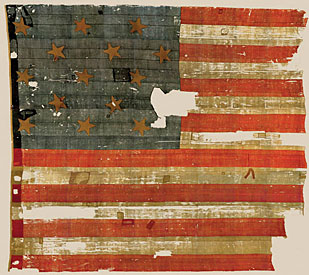
Contemporary audiences, however, will recognize the song by its more common name, "The Star-Spangled Banner".
Fun facts:
- "The Star-Spangled Banner" was named the National Anthem of the United States in 1931.
- The "Star-Spangled Banner" was sung before all major-league baseball games starting in World War Two. However, it was frequently sung during the season openers and during the seventh-inning stretch as far back as 1897.
- The flag which flew over Fort McHenry had fifteen stars and fifteen stripes.
- 61% of Americans are unable to recall all the words to the first stanza of the song.
- The "rockets' red glare" came from Congreve rockets fired by the HMS Erebus. The "bombs bursting in air" came from the mortar ships HMS Terror, Volcano, Meteor, Devastation, and Aetna. I only mention this because those are some pretty wicked ship names. Too bad ancient Greek gods of darkness aren't influential members of Congress with control over defense spending.
The Afghanistan Study Group--the MST3K version
I was about to read the Afghanistan Study Group's latest paper, when I realized it was universally panned by a number of foreign policy experts, most epically by Joshua Foust.
Maybe a group of bloggers should respond to the thing MST3K-style? Who's with me?
Edit: The Great Satan's Girlfriend tackled this subject far more sexifully than Joshua Foust. That's right. Far more sexifully.
Maybe a group of bloggers should respond to the thing MST3K-style? Who's with me?
Edit: The Great Satan's Girlfriend tackled this subject far more sexifully than Joshua Foust. That's right. Far more sexifully.
12 September 2010
9/11/01

- The SandGram
- Offshore Balancer
- The Best Defense
- Themistocles' Shade
- GSGF
- US Naval Institute
- Mother Jones
- Thinking Strategically
- Jamie McIntyre (especially important, as he tackles the 9/11 conspiracy nutjobs)
10 September 2010
US Army demonstrates LUH-72A Lakota in Germany

Be sure to check out the article, as well as JMRC's excellent collection of LUH-72 pictures at Flickr.
Great advertising, DIA
During the last days of my Freshman year in Catholic school, I heard a peculiar announcement over the intercom during the morning announcements. Our head nun gave us a stern admonishment—do not bring squirt guns to class on the last day of school.
Bring squirt guns to school? What an incredible idea!
Inspired by the nuns' inadvertent reverse-psychology, I decided to bring my Super Soaker 50 to class on the last day, laying down a field of suppressive squirt gun fire upon unsuspecting classmates.
Would that the Defense Intelligence Agency have learned from my experience in Catholic school.
Last night, I received a few Tweets recommending a salacious new book, Operation Dark Heart, written by former Defense Intelligence Agency officer Anthony A. Shaffer.
What makes it so scandalous? Well, consider the fact that DIA officials identified over 200 breaches of security in the manuscript, even after the US Army had allegedly signed off on the book in January on the grounds that it had "no objection on legal or operational security grounds", according to the New York Times.
The DIA has scrambled to purchase 10,000 copies of the book in order to prevent them from hitting the open market. Yet, in the frenzy to snatch up the books before they hit the public, they've inadvertently given it a positive review from the New York Times—a boon to any publisher.
Even before the Able Danger imbroglio, Colonel Shaffer admits in his book, he was seen by some at D.I.A. as a risk-taking troublemaker. He describes participating in a midday raid on a telephone facility in Kabul to download the names and numbers of all the cellphone users in the country and proposing an intelligence operation to cross into Pakistan and spy on a Taliban headquarters.
In much of the book, he portrays himself as a brash officer who sometimes ran into resistance from timid superiors.
"A lot of folks at D.I.A. felt that Tony Shaffer thought he could do whatever the hell he wanted," Mr. Shaffer writes about himself. "They never understood that I was doing things that were so secret that only a few knew about them."
The book includes some details that typically might be excised during a required security review, including the names of C.I.A. and N.S.A. officers in Afghanistan, casual references to "N.S.A.'s voice surveillance system," and American spying forays into Pakistan.Damn, this guy sounds like Daniel Craig's James Bond.
I doubt the DIA's efforts will be successful. They've piqued the public's curiosity, and electronic copies of the book could easily make their way onto the Internet. After all, after word of the infamous "Rolling Stan" article leaked to the press, it was distributed over the Internet, resulting in Gen. McChrystal dismissal days before the issue even hit the newsstands.
09 September 2010
Decentralized Leadership—Easier Said than Done
Colonel (Ret) Christopher Paparone penned an excellent op-ed in Small Wars Journal regarding leadership styles appropriate for "ill-structured" or "wicked" problems, such as our modern counterinsurgency campaigns, as opposed to "command", associated with "well-structured" problems.
The topic has been discussed in some detail, most notably in TRADOC's Pamphlet 525-5-500, " Commander's Appreciation and Campaign Design". However, this excerpt from Col. Parapone's article serves as an excellent primer.
Command is something associated with speed of decision-making and the critical need to do something or not do something even if the commander is not sure his/her command is the right one. The sources of power for command are coercion and compliance. Command is autocratic (hierarchical and coercive) in that it requires obedience (in its ideal form, execution-without-question).
Management (or what the US military terms ―administration) is associated with deliberate (note the meaning of the term when hyphenated: de-liberate) setting of rules, process engineering, and rationally-derived resource allocation decisions to handle tame (recurrent) problems that have been solved before. Key management values are bureaucratic and technocratic (technological). The source of power for management is regulated by legal-rational rules and procedures.
Leadership is associated with wicked situations that make command and managerial technical rationality problematic. Whether the situation is diagnosed as critical, tame, or wicked should drive whether to exercise command, management or leadership (and as Grint concludes, the complexity of the situation may demand elements of all three—and it is an art form to properly blend them). The key source of power for leadership is democratic (heterarchical) in nature in that it comes from those who, through intuitive processes and emotional responses, choose to follow.
I'm enthusiastic, yet somewhat skeptical of calls for more decentralized leadership within the Army, such as those examined in the book " The Starfish and the Spider". For starters, modern technology has given us the ability to micromanage on an unprecedented scale. For example, the Army's new Digital Training Management System could theoretically allow senior leaders to examine the training records of platoons or even individual soldiers. There's also the issue of the Army's organizational culture. Leaders can often think "in their intellectual comfort zone", usually based on their experience at more junior grades. This can unintentionally result in micromanagement as well.
Finally, As the wars in Iraq and Afghanistan wind down, and the Army moves to a more stable garrison environment—filled with well-structured problems—it will be even more difficult to foster a culture of innovation and decentralization. We will have lost the ill-structured environment which allows "leadership", as defined by Col. Parapone, to flourish.
How do we make true leadership—as opposed to command and management—a reality?
Right-Click, Copy, Left-Click, Paste does not effective communications make
In the early 1990s, it was popular to look at new forms of information technology—particularly the Internet—and envision a utopian future.
Look at the future envisioned by Gene Roddenberry in Star Trek: The Next Generation. The USS Enterprise's sophisticated holodeck—an immersive, holographic, virtual reality environment—is used solely for educational purposes and for G-rated relaxation. Of course, the last two decades of experience with the Internet have made this a laughable proposition. Were such a device to exist, you can bet that Wesley Crusher would spend his formative years sneaking off to the holodeck to look at 3-d pornography. Likewise, the ship's computer is used only for technical and educational functions, not for mass-mailing pictures of cats, as we do today. Um, that is, people other than me, of course.
Though the future of information technology isn't entirely dystopian—few can doubt the impact of the Internet on our day-to-day communications—modern information technologies can reinforce poor communication habits.
This should, of course, come as no surprise to anyone who's been reading this blog in the past few months, particularly my emphasis on relying on PowerPoint as a communications tool. But bullet-point statements, a reliance on pictures instead of words, and an emphasis on cosmetic issues aren't the only barriers to effective communication. A more insidious issue is a reliance on the simple "copy-paste" features of most computer systems.
Admit it, you've probably done it.
It's a growing problem, not just in bureaucracies, but in the educational system as well—where students can easily "write" a paper in a few minutes (albeit with facepalmingly-hilarious results when they're finally caught). It can be used properly in certain contexts—certainly we've all done it—but it can have its abuses, as well.
A few all-too-common examples.
Army headquarters at the battalion and higher levels distribute operations orders, or "OPORDS", for tactical missions. Tracing their lineage back to the short, five-paragraph orders written by the Swedish king Gustavus Adolphus in the 17th Century, they have grown into a massive beast. In modern, "steady-state" operations in Iraq, Afghanistan, and even in home station, organizations disseminate information through a daily or weekly "fragmentary order". The FRAGO, as it's known, might contain anything from tactical directives to step-by-step instructions for ordering a burger at the local Burger King . (In a curious twist of doctrine, one might even find multiple operations orders embedded within the weekly FRAGO.)
Passed from headquarters to headquarters—from a division to a brigade to a battalion—it's subject to modification, certainly, but much relevant information is simply copied and pasted as it travels through the chain of command. In fact, FRAGOs often contain so much information (when compiled on a weekly basis, a brigade FRAGO can be hundreds of pages long) that overworked staffs must frantically copy-and-paste information in order to distribute the FRAGO to lower echelons before the information becomes obsolete.
In the rush, staffs often have little time to apply a critical eye to the FRAGO. Today, modern militaries produce and disseminate so much information that—in this officer's mind—many simply give up on trying to consume and comprehend it all.
While relying on copy/paste to transmit information is understandable—albeit regrettable—many more use modern technology to arbitrarily copy and paste information from PowerPoint slides or memoranda. It's relatively simple for a user to find a PowerPoint presentation or Word document with information generally related to their line of work. With judicious Copy/Paste and a few tweaks to a slide's background or a memo's heading, a user can often pass off such documents as his or her own work.
True comprehension of material, however, doesn't always follow.
I was once in charge of compiling submissions for a comprehensive battalion "standard operating procedures"—the book on how an organization does business. After receiving chapters on logistics, air mission planning, communications, administration and maintenance from the appropriate specialty officers, it became painfully obvious that many simply copied and pasted text lifted from other organizations.
How could I tell for certain? Well, when I asked for revisions, many seemed puzzled that they made such egregious mistakes in their "work".
How egregious? How about writing about the wrong types of helicopters? (There were several mentions of OH-58D helicopters, where "Find and replace" failed to properly change the reference to UH-60).
So what say ye? What's the worst use of copy/paste you've run across?
07 September 2010
A Blog Worth Following
Some recent graduates from the University of Illinois--and Army officers to boot--have started their own blog. It's definitely worth checking out.
The Lessons of a New Generation
As I've been catching up on the weekend's happenings—the non-LEGO Whorehouse related ones, that is—I've been struck the generational differences inherent in some recent posts from milbloggers like Commander Salamander, Gulliver at Ink Spots, Elizabeth Dickinson at Foreign Policy Online, and SWJ's Major Mike Few.
The experiences an officer gains during his or her first years in service—when our minds and mores are most malleable—will shape their worldview for the rest of their careers. As such, both of America's forays into Iraq—as well as other social and political phenomena—have shaped Gen Xers and Gen Yers in very different ways.
Commander Salamander reminds us that there are many events which define each generation of officers. The generation which lived through Vietnam was so haunted by Vietnam that they threw away much of the counterinsurgency doctrine, turning their attention instead to Air Land Battle. Subsequently, Gen Xers were defined by events such the First Gulf War, the end of the Cold War, Tailhook, and the military drawdown of the 1990s—possibly leading to a sense of military hubris, and a "do more with fewer troops" attitude.
We will always owe Gen Xers a debt of gratitude, for it was they who trampled Saddam's armies in the deserts of Iraq in a 96-hour blitzkrieg. Indeed, it was this generation's all-volunteer force, armed with sophisticated precision-guided weaponry, which returned home to victory parades, vindicating the specter of the Vietnam War. But in many ways, the relative ease of Desert Storm may have added to a sense of hubris; a belief that overwhelming military force—and precision fires in particular—could solve the world's ills.
With the wars in Afghanistan turning into decade-long endeavors, there is a sense of profound skepticism among the post-9/11 generation about the utility of force, for certain. But there's something else as well. Whereas those that lived through the Vietnam War harbored their resentment towards the civilian leadership, I think many of us feel the same way about both the military and civil leadership—at least during the first few years of the war.
06 September 2010
A Brigade’s Worth of Boogie-Woogie Bugle Boys?
Don't get me wrong; I'd like to consider myself a patron of the arts (particularly certain LEGO projects). However, if Secretary Gates is trying to trim some fat from the DoD's budget, he might want to consider that the US Army alone has slots for 4,600 band members, according to a recent article in the New York Times. That's more than an entire brigade combat team's worth of band members.
(According to doctrine manuals, a Stryker Brigade Combat Team should have approximately 3500 soldiers)
The surge strategy in Iraq of sending troops to distant outposts "left a lot of soldiers out there where there wasn't entertainment or morale-type things," he said. The increased use of helicopter transportation in such a conflict zone also argues in favor of smaller groups. The Army band world has adopted an informal motto, Colonel Palmatier said: "If it can't fit into two Blackhawks, it's not going to happen." (Blackhawk helicopters can generally hold 4 crew members and 14 troops.)
The high-profile, large-scale Army bands, of course, remain. Along with the Army Field Band, which tours heavily, they include the United States Army Band, informally known as "Pershing's Own" or not so informally as Tusab. There are also the United States Military Academy Band and the Old Guard Fife and Drum Corps. The Army has 30 more bands on active duty, as well as 70 Reserve and National Guard bands. All told, it has slots for 4,600 band members.
Army bands have plenty of company in the other services. The Navy has 13 bands; the Air Force maintains 12 active-duty bands, joined by 11 in the Air National Guard; the Marine Corps sponsors the United States Marine Band ("the President's Own") of White House renown, and a baker's dozen other active-duty bands.
[Army bands are divided] into categories: large, usually assigned to an Army command; medium, for the corps level; and small, for division headquarters or individual installations. The bigger the band, the more performance teams.
Note that this article only tackles "official" military bands. God only knows if they took into consideration organizations like the 82nd Airborne Division Chorus and other ensembles.
With a steady increase in the number of generals—a phenomenon Secretary Gates refers to as "brass creep"—comes a natural increase in the number of bands. And calls to reduce bands—however superfluous they might be—will be met with resistance. Consider that division-level bands—which typically cater to the vast majority of funerals and changes of command—are mirrored by even larger Corps- and Army-level bands.
Focus: What do you think? Are all the military bands worth it? What's the greatest performance you've ever seen from a military band?
Catching up
I have a lot to catch up on after this weekend, judginag by the 400 unread items in my Google Reader feed. Lest anyone doubt my weekend absence was in vain, I give you pictures of a bona-fide LEGO Red Light District.

I wanted to proclaim my elation at this serendipitous discovery from the top of a mountain. However, lacking a mountain, I decided to simply post a picture on Twitter.
JimmySky had the best response.
"Be careful. This sounds like one of those square peg/round hole situations".

I wanted to proclaim my elation at this serendipitous discovery from the top of a mountain. However, lacking a mountain, I decided to simply post a picture on Twitter.
JimmySky had the best response.
"Be careful. This sounds like one of those square peg/round hole situations".
05 September 2010


01 September 2010
Naval Alliance FAIL
Journalist Carl Prine recently alerted me to the news that the British and French, due to budget constraints, will actually be pooling their aircraft carrier fleets. Thus, Britain and France will be able to keep at least one of their three aircraft carriers--the HMS Ark Royal, the HMS Illustrious and the Charles De Gaulle--at sea at any one time.
I, for one, am a tad cynical. The British and French navies are, quite possibly, the only navies that have done more harm to one another as allies than they have as enemies. In 1940, the British sank an entire French fleet off the coast of Algeria, killing over 1200 French sailors, for fear that the Germans--having recently accepted the French surrender--might use the French battle fleet against them. (H/T Rex Brynen for the reference to that one)
Over forty years later, during the Falkland Islands War, the British fleet was menaced by a new sea-skimming anti-ship missile which crippled or sank a number of British warships, most notably the HMS Sheffield. The new weapon, of course, was the Exocet missile, manufactured in France and sold to the Argentinians.
Horatio Nelson must be rolling in hisgrave cask of brandy.
I, for one, am a tad cynical. The British and French navies are, quite possibly, the only navies that have done more harm to one another as allies than they have as enemies. In 1940, the British sank an entire French fleet off the coast of Algeria, killing over 1200 French sailors, for fear that the Germans--having recently accepted the French surrender--might use the French battle fleet against them. (H/T Rex Brynen for the reference to that one)
Over forty years later, during the Falkland Islands War, the British fleet was menaced by a new sea-skimming anti-ship missile which crippled or sank a number of British warships, most notably the HMS Sheffield. The new weapon, of course, was the Exocet missile, manufactured in France and sold to the Argentinians.
Horatio Nelson must be rolling in his
Your PowerPoint Quote of the Day
The brass may not have approved of Col. Lawrence Sellin's now-infamous anti-PowerPoint rant, but legions of frustrated PowerPoint Rangers wholeheartedly agree. Just check out these responses to Sellin's article.
And note that these snarky sentiments are expressed in coherent words and sentences--the way they should be.
(And more well-written than my post yesterday, that's for sure. Thanks for the suggested revisions, guys!)
And note that these snarky sentiments are expressed in coherent words and sentences--the way they should be.
(And more well-written than my post yesterday, that's for sure. Thanks for the suggested revisions, guys!)
"Sadly, [Colonel Sellin] is right," wrote commenter Carl F. of Dallas. "The military has become so enamored with PowerPoint that it is rapidly losing track of its real mission and replacing it with a pablum-type spoon-fed mini-information series of slides that can't come close to truly clarifying muddy water, much less the war. Unfortunately, if today's military leaders were to put up against the Axis forces of [World War II], we'd all be speaking German or Japanese -- which we'd learn from them via PowerPoint."
Responding to Carl F., reader C.J. wrote: "I'm not so sure we'd be speaking German or Japanese at this point, but because the 'briefing' mentality is pretty cross-cultural, I'm more inclined to think we'd still be fighting some offshoot of the 18th and 19th century global colonial wars. Oh, wait..."