Showing posts with label OODA. Show all posts

08 January 2010

Excellent articles from Adam Elkus

If you haven't checked out Adam Elkus' latest articles in Red Team Journal and at Open Democracy, you need to. A few snippets...

From "New Years' Resolutions for Strategic Theory", regarding the COINdinistas and COINtras:

The emerging strategic debate of the 2010s is the clash between “COINdinistas”–soldiers and civilian thinkers who believe that counterinsurgency and stability operations is the immediate future of war and deserve special consideration–and “COINtras” who are suspicious of the COIN’s doctrinal assumptions, warn of strategic overreach, and focus instead on building up traditional combined arms competencies. While it is difficult to see how both views can be reconciled (and rightly so, we need the debate), both get important things right. The military is ultimately a tool of policy, and counterinsurgency has to be integrated into the strategic toolkit available in order for US policy to be accomplished. U.S. involvement in insurgency and counterinsurgency has been constant since 1776 and shows no sign of going away. That being said, COINtras, who tend to espouse Realistviews, are correct that the United States is currently overstretched and should not seek out intervention with general purpose forces. Moreover, even the favored model of special forces and drones should not be so easily resorted to. Lastly, the COINtras do have a point about COIN theory’s weaknesses. The larger problem, however, is the nation’s post-Cold War strategic drift–and both COINdinistas and COINtras can and should agree that the real issue is not COIN or “Big Army” but America’s problem with strategy.

From "Science, Defence and Strategy" regarding the development of doctrine"

For the military, the quest for doctrine and training adaptive enough to create a military capable of carrying out complex conventional and irregular missions is likely to be a decades-long pursuit. It took thirty years for the Army to experience a post-Vietnam renaissance in doctrine and training that would eventually result in the lopsided victory over Iraq in the first Gulf War. But military needs will be ultimately driven by the nature of American strategy. And when strategy is absent, science, whether rooted in technology, operational art, or social science, will take over. So what is to be done?

One of America’s greatest (but little-known) strategic thinkers ironically found the answer in science itself. Air Force Colonel John Boyd busied himself with an expansive reading list after retirement, synthesizing insights from the emerging discipline complexity science along with the timeless lessons of classic military history. An iconoclastic figure, Boyd is known for declaring “If you've got onedoctrine, you're a dinosaur.” While Boyd’s insights are often reduced down to the idea that one should simply be faster than the enemy, his real ideas were far more complex.

In Boyd’s paper “Destruction and Creation,” the widely read Colonel synthesized mathematicians Kurt Gödel and Werner Heisenberg’s insights in pointing out that inward-oriented efforts to force observed reality to mesh with internally derived concepts only increase chaos and destruction. It is impossible to determine the consistency and character of an abstract system within itself (See John R. Boyd, “Destruction and Creation,” September 3, 1976). Boyd noted that this had potentially dire consequences for rigid closed systems...

...The human decision-making process, Boyd argues, deals with this conundrum through a constant dialectic of creation and destruction of mental patterns and perceptions in response to a changing and complex observed reality. We cannot escape from chaos, rather we are most successful when we embrace it by shattering the rigid mental patterns that have built up and then synthesize the new realities we observe to create a new understanding. Such a process of structuring, dissolving, restructuring, and dissolving again must be repeated endlessly.

Contemporary American strategic problems flow from the fact that we cannot adjust the ossified thinking of Washington D.C. to the constantly shifting observed reality of the outside world. A failure to match concepts to observed reality has amplified the already formidable entropy of the American political system. The corresponding failure to make strategy results in a search further inward towards the “science” of war. Better strategy will come about only when the process by which strategy is made becomes supple, flexible, and less dominated by sacred cows and special interests.

And finally, your daily dose of Clausewitz:

Clausewitz did not believe in the “trinitarian” framework often ascribed to him. Neither was he responsible for World War I. He didn’t invent political correctness. And the 200-year old Prussian is not responsible for the formula-like (and very Jominian) way that his ideas are used in US military education and doctrine. Rather than using poor old Carl von as a foil for new ideas, those ideas should be advocated on their merits.

02 November 2009

Your Counterinsurgency of the Day

The recent, drastic increase in casualties in Afghanistan--over 1,000 killed or wounded in the last three months--is, unfortunately, par for the course when conducting full-blown counterinsurgency. To steal T.E. Lawrence's old quote, it is slow, and it is incredibly messy, especially when done properly.

It also serves as a great source of partisan in-fighting. Take House Minority Leader John Boehner, who said:

"We've had the highest casualty troops in years over the last month or two. Why? Because of all the uncertainty around what the president is going to decide."

Nice try, but it's nowhere near close. The increase in casualties might be more due to a.) a series of aircraft crashes last week, b.) the battle at COP Keating, c.) a massive offensive in Helmand province by British troops and US Marines this summer, and d.) an increase in the number of NATO troops and their tendency to conduct a large number of dismounted patrols. (These sorts of patrols, while risky, pay off immensely, and are far more successful than the Super-FOB strategy or the "commute to war" approach)

Indeed, I don't mind President Obama taking his time reviewing the potential Afghan strategy. As Sun-Tzu was quick to point out, war is the most serious affair of the state, and should only be conducted after great deliberation. Even those who love to talk about their quick "OODA Loops" must realize that if we don't get the "orient" phase right, your OODA Loop will look more like an OODA scribble. Okay, that analogy was really, really bad, but you get the point.

Kris Alexander had the quote of the day on this issue, posting in Small Wars Journal.

Maybe after eight years of Bush everyone has forgotten what a deliberative planning process looks like. I am refreshed by an actual decision making process versus cooking the books to support a "gut" decision.

25 October 2009

Classic Post re: women, alcohol, and 4GW

Those of you who know me personally may have wondered when I became a counterinsurgency blogger instead of a blogger who concentrated on his weekend debauchery? Fear not, because I have a bit of a blast from the past--a post I made last year in another blog which combines the best of 4th Generation Warfare theory and debauchery at the club. Let's watch:

Originally posted 20 January, 2008:

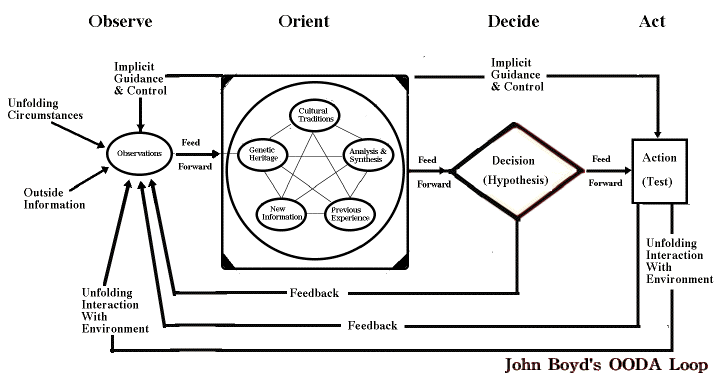
I've talked earlier about the famous OODA Loop, a theory of warfare and business based on the writings of fighter pilot Colonel John Boyd. Essentially, it represents a decision cycle which everyone--from the tiniest one-celled organism to the largest bureaucracies--must undergo in order to spark action and adaptation to unfolding circumstances, the key to success in any arena.


Note: Boyd notes that Decide and Act can often be done simultaneously, especially when one has a highly developed sense of intuitive thinking and knows exactly what needs to be done in many situations (often developed by experience). This can also, in my case, be a result of alcohol.

But could OODA be applied to talking to women at the club? The Intel Officer and I go undercover at SUNY-Oswego in order to find out.

True to form, the Intel Officer had credible intelligence to suggest that SUNY-Oswego had bars and girls. Unfortunately, when we got to Oswego, we found out the intelligence was flawed, as SUNY-Oswego was not in session for another few weeks.

We went into a few bars to see whom we could talk to. We wound up going to one club, where, after a few beverages, I needed to relieve my bladder. I was trying to get over the fact that I didn't remember college-aged girls looking so, well, young, when the Intel Guy came up to me and told me that he had struck up a conversation with two girls who wanted to "dance". (I put that in quotation marks because, well, after watching the pure awesomeness that was the Stormtrooper Dance from yesterday's entry, this didn't qualify as dancing.)

That's when I noticed something alarming about these two girls.

Observe: I see little X marks on the hands of these two girls.
Orient: Previous experience has taught me that this means that someone is under 21, which is not good in my current predicament.
Decide-Act: I make some nonverbal gestures at the Intel Officer which basically means we need to get the hell out of there quickly.

Observe: One girl starts to pop her collar.
Orient: Analysis and Synthesis...I remember that popping one's collar is a part of a great Chuck Norris joke. Previous experience tells me that everyone loves those Chuck Norris Jokes.
Decide-Act: I say, "So, you're popping your collar? You know, Chuck Norris doesn't pop his collar. His shirt just gets an erection from being on his back."

Now we have an unfolding interaction with the environment, which leads me to observe this:

Observe: The girl is not laughing at my joke. Instead, she has a puzzled look on her face and asks, "Who's Chuck Norris"?
Orient: How the hell does this girl not know who Chuck Norris is? Cultural traditions and previous experience have told me that this either means that a.) She's way too young to know who Chuck Norris is or b.) She's an idiot. I realize that since Chuck Norris jokes are all over collegehumor.com, the average college student must be aware that they exist, so I settle on a.) this girl is an idiot.
Decide: I need to bail now.
Act: The Intel Officer is still doing well with his girl, so, being a good wingman, I decide to wait this one out.

Fortunately, I observe that...

Observe
: The girls want to leave the club to go eat.
Orient: I realize that this will give us an excellent opportunity to escape.

This constitutes a mini-OODA loop within a larger one. (You can go backwards through the loop, according to the diagram, as you constantly process new information).

Observe: The Intel officer must be reading my mind, because he says, "We should leave, like now".
Orient: I realize that there is no more perfect time to do so.
Decide-Act: As the girls are placing their order, presumably expecting us to pay for everything, the Intel Officer and I bail out the back door of the pizza place, hopefully leaving these girls to pay for their meal unexpectedly. Heh heh heh.

Bonus--Quote of the Evening:

Girl who doesn't know who Chuck Norris is: (Looking at my beer) Do you drink until women look cute?
Me: No, but tonight's a good night to start...

22 May 2009

The best-laid plans

For at least twenty years prior to the First World War, German planners developed, honed and revised the "Schlieffen Plan", which was probably the most meticulous battle plan ever created...and still lost. Part of the reason this plan didn't work was because it, like many military plans, didn't allow for sufficient flexibility.

An old maxim of combat is that no plan ever survives the first ten minutes of contact, and many times, this is true. One of the greatest military strategists of the modern era, Colonel John Boyd, studied many successful generals who practiced the art of "maneuver war", such as Ghengis Khan and Erwin Rommel. What he discovered was that successful maneuver armies not only have plans to accomplish their primary objectives, but also have "branches" in their plans, to allow for greater flexibility. For example, junior leaders not only have their primary objectives, but secondary ones as well, should the primaries not be attainable. Boyd also noted that great armies and organizations (much like animals) were not necessarily the strongest armies, but the ones which were the most responsive to changing conditions on the battlefield.

All operations involve some degree of the unknown, and will be subject to forces well outside of anyone's control. This week, I had just that sort of operation. The plan and the timeline were in a constant state of due to a number of factors--sandstorms, broken aircraft, meetings that go on forever, you name it. Just when you think you have the plan finalized, a sandstorm delays things for days.

Everyone involved in the operation can easily get frustrated. But the frustration that occurs, the blaming of one another when things don't happen as planned, all this leads to what Clausewitz called "friction". This is exactly what the maneuver warfare artist seeks to exploit in other armies, and exactly what we need to avoid in our organizations.

So relax, accept the change, and move on with life. Nothing is ever certain. Just execute a superior OODA Loop and you'll be all right.