"The nation that will insist upon drawing a broad line of demarcation between the fighting man and the thinking man is liable to find its fighting done by fools and its thinking by cowards."
Sir William Francis Butler
10 June 2010
Human Rights Watch Film Festival in NYC
08 June 2010
Epic Taliban FAIL
Something tells me that they might want to get a job in something other than insurgency.
H/T Matt Gallagher. (PS--buy his book)
07 June 2010
It really is the tribes, stupid...
I guess it really is the tribes, stupid.
In little more than two years, Mr. Matiullah, an illiterate former highway patrol commander, has grown stronger than the government of Oruzgan Province, not only supplanting its role in providing security but usurping its other functions, his rivals say, like appointing public employees and doling out government largess. His fighters run missions with American Special Forces officers, and when Afghan officials have confronted him, he has either rebuffed them or had them removed.
“Oruzgan used to be the worst place in Afghanistan, and now it’s the safest,” Mr. Matiullah said in an interview in his compound here, where supplicants gather each day to pay homage and seek money and help. “What should we do? The officials are cowards and thieves.”
Mr. Matiullah is one of several semiofficial warlords who have emerged across Afghanistan in recent months, as American and NATO officers try to bolster — and sometimes even supplant — ineffective regular Afghan forces in their battle against the Taliban insurgency.
In some cases, these strongmen have restored order, though at the price of undermining the very institutions Americans are seeking to build: government structures like police forces and provincial administrations that one day are supposed to be strong enough to allow the Americans and other troops to leave.
27 May 2010
Ft. Leavenworth COIN Symposium
19 May 2010
Who needs imagination?
KABUL, Afghanistan — Taliban insurgents launched a brazen assault on the American base at Bagram on Wednesday morning, sparking a large and confusing gun battle that left at least five American soldiers wounded and seven guerrillas dead.
Taliban leaders claimed that seven suicide bombers had blown themselves up at the gates of the base, clearing the way for more than 20 other fighters to get inside. The Taliban reports appeared exaggerated, as they often are. But American officials confirmed that the base, one of the largest in Afghanistan, had come under an ambitious and unusual assault.
An American official said that the base had come under attack by as many as many as 30 insurgents. Another American spokesman, Col. Wayne Shanks, said that no suicide bombs had exploded and that no insurgents had entered the base. “At no time were Bagram defenses breached,” he said.
American officials said that the attack had ended by midmorning Tuesday.
Still, details were sketchy. The main road leading to the base was sealed, and helicopters could be seen flying over the area. Local residents reported hearing gunfire around the base.
The Bagram base, located about 50 miles north of Kabul, the capital, is one of the main hubs of the American campaign in Afghanistan. Bagram serves as the headquarters for the military’s efforts in eastern Afghanistan. It is ringed by several layers of defenses.
The assault on Bagram comes on the heels of an attack Tuesday by a suicide bomber in Kabul, who rammed an explosives-laden bus into an American convoy, killing 18 people, including five American soldiers and a Canadian officer.
18 May 2010
Talk about your "strategic corporals"
PUZA-I-ESAN, Afghanistan – Living at a remote Afghan National Army outpost in northern Afghanistan, two U.S. Army Soldiers operate autonomously to ensure construction projects for ANA and Coalition soldiers are completed correctly and on time.
Specialists Daniel Booles, contracting officer representative, and Joseph Wagner, COR assistant, who are attached to the Regional Support Team-North at Camp Mike Spann, oversee mission-essential construction at combat outposts across northern Afghanistan. They support the Afghan National Security Forces in efforts to defeat the insurgents and secure the population.
Establishing these combat outposts is critical to the success of the ANSF as they assist with sustaining a presence in the region. This is an integral part of the counterinsurgency initiative, supporting the ANSF mission with the ability to clear an area, hold with security forces, and build support while protecting Afghans.
Team members monitor contracts to build and expand ANA combat outposts to ensure that supplies used to sustain forces are received and that correct construction materials are timely delivered. The pair serves as the RST’s eyes and ears, a critical task that comes with unique obstacles and challenges.
“Being dropped off at a Forward Operating Base without a vehicle, interpreter, and limited supplies definitely made our mission a challenge,” said Spc. Daniel Booles, a Fort Worth, Tex. native assigned to the 10th Mountain 1st Brigade 2-22 Infantry Delta Company from Fort Drum, N.Y. “Making sure equipment and supplies made it to the right locations by the contractors was an interesting experience.”
Ensuring timely delivery of materials by local contractors sometimes requires eliciting the assistance of international partners in the region while they dually work to organize logistical support from other U.S. units operating in the area.
“We had to coordinate with the Germans as well as the ANA to ensure delivery to Bashir Khan,” said Spc. Joseph Wagner, a Crittenden, Ky., native also assigned to 10th Mountain 1st Brigade 2-22 Infantry Delta Company from Fort Drum, N.Y. “I’m glad we were able to get everything done and I am ready for the next mission.”
Despite the remote location and austere conditions, the modest pair managed to ensure the completion of the combat outpost at Puza-i-esan, a critical project that directly contributed to bringing stability to an area that once served as a safe haven for insurgents.
“I liked the autonomy, it was nice to get out here and put our training to work,” Booles said.
Completing the complex project together brought the duo closer during their embedded experience with the ANA soldiers, where they were often the only familiar face each other had.
“I can’t ask for a better partner,” Booles said of his cohort. “We definitely formed a big brother – little brother relationship.”
Upon returning to their home base at Camp Mike Spann, the two-man team moves on to their next assignment: a 30-day project overseeing the expansion of living space for incoming troops at a 209th Corps combat operating post in Khilagay, Afghanistan.
29 April 2010
Still the King of Battle
Michael Yon snapped some amazing pictures of a cannon crew from Ft. Lewis' 3-17 Field Artillery. In Afghanistan, cannon artillery is still a vital player on the battlefield, as the Taliban tends to operate in more rural areas, far from major population centers, and is known to gather in large numbers.
12 April 2010
On the Afghan Convoy
Before dawn this morning, an unknown, large vehicle approached a slow-moving ISAF route-clearance patrol from the rear at a high rate of speed. The convoy could not move to the side of the road to allow the vehicle to pass due to the steep embankment.
The ISAF patrol warned off the approaching vehicle once with a flashlight and three times with flares, which were not heeded. Perceiving a threat when the vehicle approached once more at an increased rate of speed, the patrol attempted to warn off the vehicle with hand signals prior to firing upon it. Once engaged, the vehicle then stopped.
Upon inspection, ISAF forces discovered the vehicle to be a passenger bus.
An ISAF patrol was traveling through a city at a high rate of speed, driving down the center to force traffic off the road. Several pedestrians and other vehicles were pushed out of the way. A vehicle approached from the side into the traffic circle. The gunner fired a pen flare at it, which entered the vehicle and caught the interior on fire. As the ISAF patrol sped away, Afghans crowded around the car. How many insurgents did the patrol make that day?
11 March 2010
For those keeping score
Foreign Policy Online has a great roundup of the most recent deaths and arrests among Taliban and Haqqani operatives.
04 March 2010
The trail heats up?
I haven't seen much reaction to this article from the Times Online in the blogosphere (H/T SWJ). It appears that the Pakistani Army captured a series of over 150 caves near the Afghan-Pakistani border, believed to have harbored al-Qaeda. The story gets even better: according to the article, Ayman al-Zawahiri, al-Qaeda's number two operative--some say the real brains of al-Qaeda--may have been in the cave complex just shortly before the raid.Pakistani forces have taken control of a warren of caves that served until recently as the nerve centre of the Taleban and al-Qaeda and sheltered Ayman al-Zawahiri, the second-in-command to Osama bin Laden.
“It was the main hub of militancy where al-Qaeda operatives had moved freely,” Major-General Tariq Khan, the Pakistan regional commander, said as he gave journalists a tour of Damadola yesterday.
The village, nestling among snow-capped peaks in the Bajaur region along the Afghan border, has been fought over for 16 months. It is the first time that the Pakistani Army has set foot in the village, which had long been dominated by the insurgents operating on the both sides of the Pakistan-Afghanistan border.
“Al-Qaeda was there. They had occupied the ridges. There were 156 caves designed as a defensive complex,” said General Khan, head of the Frontier Corps responsible for Pakistan’s counter-insurgency campaign in the region. He said that his forces had killed 75 foreign and local militants and cleared a zone up to the Afghan border, and that the campaign against the insurgents was in its final stage...
...Journalists were shown caves strewn with blankets and pillows, left in haste as the army approached in January. The village has been largely destroyed by the fighting...
...According to officials he and some other al-Qaeda operatives had been attending a dinner but left just before the attack. The ruins of the house hit by the missiles were still present...
This comes hot on the heels of Pakistan's capture of nearly half the Quetta Shura--the inner circle of Taliban leaders--just last week.
19 February 2010
Baradar's Arrest: More Questions Than Answers...
- Until recently, the Pakistani government has outright denied the existence of what we term the Quetta Shura--essentially a high council of leaders from the remnants of the ousted Taliban, believed to have been hiding in the Pashtun-dominated city of Quetta, in Baluchistan province of Pakistan. Now we see Mullah Baradar's arrest in the city of Karachi, a port city, and one of the largest cities in Pakistan. Was Mullah Baradar captured in the city? Are Taliban leaders currently hiding in one of the largest cities in Pakistan? Would al Qaeda leaders be moving with Taliban leaders, or do they remain in the border regions?
- Mullah Baradar had advocated a less brutal approach than Mullah Omar and many other Taliban leaders, and had also seemed to be spearheading an effort to reach some sort of settlement with the Afghan government. Are we witnessing an ideological shift and, maybe, a split away from the Taliban as a result of its tactics? Certainly, it wouldn't be without precedent. Al Qaeda in Iraq saw its ranks thin after their campaign of brutality--largely directed at their fellow Muslims--tarnished their image and led to the Awakening movements. Al Qaeda central is also finding it difficult to recruit. Could it be that the Taliban are also finding it difficult to hang on to their supporters as well?
17 February 2010
The Fortress of Baradar--Reflections
09 February 2010
82nd Airborne Division Medevac in Action
Thanks to Greg Williams for the link to today's Charlotte Observer, which had over a dozen excellent pictures of medical evacuation helicopters in Afghanistan. The helicopters belong to the 3rd General Support Aviation Battalion and to the 2nd Assault Helicopter Battalion of the 82nd Combat Aviation Brigade. You might remember the 2-82 Assault Helicopter Battalion after witnessing their battalion commander in action, landing her UH-60 Black Hawk on one wheel on the side of a mountain. 

06 February 2010
In case you didn't get the memo
Two very sound reasons for the lack of operational secrecy suggest themselves. First, I’d back the insurgents to know something was coming, even without a subscription to the [Wall Street] Journal.
Second, more importantly, avoiding a big fight is the name of the game for the coalition. Preserving your force and securing the people are key objectives if you’re going to do population-focused counterinsurgency. Ideally you want to take control of the populous areas with minimal fighting, and you want the insurgent out in the sticks, where he can be hunted down more readily than among the population, and where there’s less chance of large-scale civilian casualties.
The insurgent, meanwhile, must fight among the people, not just for safety, but to retain his relevance. Announcing that you’re coming gives him a tough choice.
Ted Striker: My orders came through. My squadron ships out tomorrow. We're bombing the storage depots at Daiquiri at 1800 hours. We're coming in from the north, below their radar.
Elaine Dickinson: When will you be back?
Ted Striker: I can't tell you that. It's classified.
05 February 2010
Afghanistan and the Poppy Trade, Redux
13 January 2010
Uh, guys...
CAMP PENDLETON, Calif. — U.S. forces have driven the Taliban from most towns and villages in the strategic Helmand province of Afghanistan, leaving incoming troops with the mission of holding key areas and rebuilding the economy, Marine commanders say.
"They've taken on the Taliban, the insurgency, right in the heartland, and they've defeated them," Marine Maj. Gen. Richard Mills said in an interview with USA TODAY.
Commanders warn that Taliban forces remain dangerous and could mount a resurgence. Six coalition soldiers were killed in attacks around the country Monday. Still, the developments in Helmand could have broad implications for the war because of the province's importance to the Taliban.
Much of the Taliban's leadership and support comes from the mostly Pashtun province and nearby Kandahar. Helmand, the country's largest province, also produces most of the country's poppy crop, which has helped fund the insurgency.
Recent attention has been focused on President Obama's orders to send about 30,000 reinforcements to Afghanistan this year. But an influx of Marines to Helmand province last year has produced dramatic results, raising hopes that the gains can be consolidated and spread elsewhere, Mills said.
Mi-35 Hind Awesomeness
30 December 2009
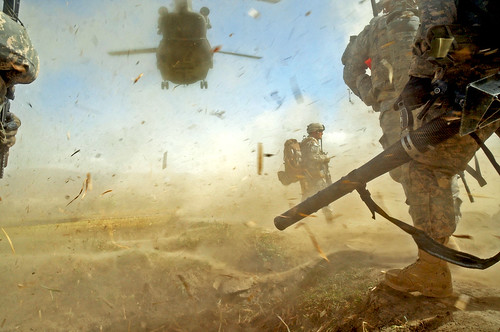
Air Assault in Paktika Province, Afghanistan
and UH-60 Black Hawks from the 3rd Combat Aviation Brigade (home stationed at Fort Stewart, Georgia) conducting an air assault into Paktika province in eastern Afghanistan.
29 December 2009
Army Aviation Video of the Day
16 December 2009
Since the UH-60 Black Hawk needs some love...