"The nation that will insist upon drawing a broad line of demarcation between the fighting man and the thinking man is liable to find its fighting done by fools and its thinking by cowards."
Neil "Cavguy" Smith (whose awesome visage can be found in this picture), a regular writer for Small Wars Journal, has written an excellent article regarding the application--and misapplication--of T.E. Lawrence's most favorite quote, which is quickly being relegated to the realm of cliche in modern counterinsurgency:
Do not try to do too much with your own hands. Better the Arabs do it tolerably than that you do it perfectly. It is their war, and you are to help them, not to win it for them. Actually, also, under the very odd conditions of Arabia, your practical work will not be as good as, perhaps, you think it is.
--T.E. Lawrence, The Arab Bulletin, 20 August 1917
Cavguy paints a wonderful vignette of how this quote is practically applied, and applied well. But not everyone has applied this quote to great effect. Bob Woodward's The War Within, an inside look at the decisions which led to the Troop Surge of 2007, begins with General George Casey refusing to ask for more troops, and insisting that US troops continue to play an advisory role, using the aforementioned quote from Lawrence...
...and misattributing it to Seven Pillars of Wisdom. Seriously, bad form.
But aside from the literary criticism, the quote was misapplied for a second reason. As the counterinsurgency manual notes, the key word in Lawrence's quote is tolerably. In 2006, the Iraqi Security Forces weren't performing tolerably--they were part of the problem. It meant that US troops had to step in to take the lead in 2006.
Kings of War hosted a good point/counterpoint session between two people regarding the merits and drawbacks of "lateral entry" into the military--that is to say, joining the military from the outside world, and starting off at the rank of, say, captain or major.
It's not entirely without precedent, particularly in wartime. Note the extremely rapid advancement (by today's standards) of many officers in the US military upon the outbreak of World War Two. Additionally, Dr. David Betz of King's College in London uses T.E. Lawrence, who first joined the British Army in 1915 and attained the rank of lieutenant colonel by war's end, as an example of a successful lateral entry into the British military.
Indeed, Lawrence seems to have greatly benefited from not having experience in the British Army; he was free of the terrible preconcieved notions of warfare which plagued many British officers. Lawrence based his guerrilla campaign against the Turks on his in-depth reading of military history, rejecting the conventional military wisdom of the day.
However, we must acknowledge that Lawrence was truly an exceptional case. Lawrence's upbringing, education, and archaeological work prepared him for guerrilla war in Arabia. Although Lawrence lacked many "military" qualities, most notably the spit-and-polish look of a British officer (even when he wasn't dressed in Arab garb), he made up for his shabby appearance in other areas. Lawrence spent a great deal of time before the war excavating ruins in modern-day Jordan and Syria, becoming familiar with much of the territory in which he would later fight. During his travels, Lawrence became a decent shot with his pistol, learned to speak Arabic fluently, and developed such incredible stamina that he could cross the Nefud desert on camel alongside experienced Bedouin tribesmen. Such skills were hardly commonplace in British officer training programs. Indeed, many descriptions of cadet life at Sandhurst place much more emphasis on playing sports than learning languages.
Moreover, Lawrence' skills--language, physical conditioning, exceptional knowledge of military history--would be even more rare among civilians today. In fact, a recent study indicated that over 70% of Americans would be unfit to even enlist as a private in the first place, due to factors such as obesity, medical waivers, mental health, educational requirements, family readiness, or criminal records.
Even if one does find exceptional leaders who pass the basic requirements for entering the military, there's also a few more hurdles to overcome. These leaders must first be trained in their warrior tasks. For example, picking up a Bell 206 pilot off the street doesn't mean he can be thrown into an OH-58D as a fully-rated combat pilot. The basic warrior skills and tactical leadership take years to hone.
Last but not least, commanders at all levels need experience in mastering the ins-and-outs of military bureaucracy in order to be successful. They need to know the things that you won't read in a military history book: how to coordinate with the civilians at Range Control for training resources and ammunition, how to apply for on-post housing, military legal matters, developmental timelines, property book issues, office politics, additional duties, and last but not least, how to write in the Army writing style.
Indeed, the sheer magnitude of bureaucracy generated by a modern military organization would serve as a near-insurmountable goal for a commander, should he or she have a year or less experience. Lawrence could afford to not have as much bureaucratic experience--his Bedouin army had no payrolls, minimal property, no formations or duty rosters, and most importantly, few individuals capable of reading and filling out paperwork in the first place.
While some can transfer into the military from the outside world, let's face it, it's a rare individual that can do so in a rare situation.
Adam Elkus pointed me towards some great reading on Effects Based Operations and Systemic Operational Design. (I swear that I do go out on Saturday nights) Most notably, he pointed me towards a critique of SOD written by Milan N. Vego. I will fully incorporate Mr. Vego's thoughts into a coherent essay, but it's funny how many times he brings up the fact that SOD--the military's new planning process for complex environments like Afghanistan--is based on French postmodern theory.
It's almost as if he brings this up in the same way COINtras point to FM 3-24 and note that it's based on French Captain David Galula's experiences in Algeria--as if coming from a French source discredits its military value completely (the Franco-phobia was soooo 2003...get over it).
I should also point out the fact that David Galula isn't the only one who gets heavy mention in FM 3-24: Counterinsurgency Theory and Practice. T.E. Lawrence also gets plenty of ink in the new manual. Which is certainly to be expected--Lawrence was one of the greatest writers and thinkers on the topic of insurgency in the 20th Century, (in fact, Seven Pillars of Wisdom is my favorite book of all time).
But what makes his inclusion in FM 3-24 chuckle-worthy is that that an American military manual heaps great praise upon a British officer who, according to a number of biographies, might not have been completely straight.
I try to avoid making Vietnam comparisons in the Afghan debate, but sometimes it's unavoidable.
Take today's post by Londonstani in Andrew Exum's "Abu Muqawama", in which Londonstani and British General Sir David Richards invoke the old "Domino theory" argument from the Vietnam era. Says Gen. Richards in the Telegraph:
He said: "If al-Qaeda and the Taliban believe they have defeated us – what next? Would they stop at Afghanistan? Pakistan is clearly a tempting target not least because of the fact that it is a nuclear-weaponed state and that is a terrifying prospect. Even if only a few of those (nuclear) weapons fell into their hands, believe me they would use them. The recent airlines plot has reminded us that there are people out there who would happily blow all of us up."
Cute, but hardly accurate. Keep in mind that the Taliban ruled Afghanistan throughout the 1990s and seemed largely uninterested in Pakistan.
But wait, there's more to the Taliban's dastardly plans:
He said: "Failure would have a catalytic effect on militant Islam around the world and in the region because the message would be that al-Qaeda and the Taliban have defeated the US and the British and Nato, the most powerful alliance in the world. So why wouldn't that have an intoxicating effect on militants everywhere? The geo-strategic implications would be immense."
All right, so the monolithic Takfiri Jihadists in the world will then band together and continue taking over every country at will if we abandon Afghanistan? I have my doubts. The last time we invoked the Domino argument was Vietnam, and it was an utterly false assumption: after the US withdrawal from Vietnam, there were more wars among the Communist countries of Southeast Asia than anything else: Communism completely failed to take hold over the rest of Southeast Asia. Just as there was no monolithic Communism, there certainly is no monolithic Muslim jihadism (in case you didn't notice from all the sectarian violence going on).
One of the worst strategic blunders on the part of al Qaeda (and similar takfiri groups) is their propensity to cause mass civilian casualties among the Muslim community--significantly reducing their appeal. They also appear to have little interest in actual nation-building and governance. (T.E. Lawrence said it best--insurgents rarely make effective civil leaders). Especially in light of the elections in Iran, which showed considerable disinterest in the leadership of the ayatollahs and the like, I have my doubts that the Muslim world is going to rush to accept militant jihadism as a form of governance in the wake of an American withdrawal.
Our first link is "A Modern War Reader", which is a counterinsurgency reading list posted by Jules Crittenden, but taken from JH Stuart. I think I am going to have to put together my own counterinsurgency/4GW reading list in the near future to compliment my "what's on my bookshelf" post which earned me an entry in the blog Omnivoracious, entitled "Lawrence and Lad Lit: A Helicopter Pilot's Bookshelf". In the meantime, though, I'll link to Jules Crittenden's COIN reading list, which features a great analysis of my favorite book about insurgency (and favorite book of all time), Seven Pillars of Wisdom by T.E. Lawrence. Crittenden should be commended for noticing the difference between the 1926 and 1922 editions.
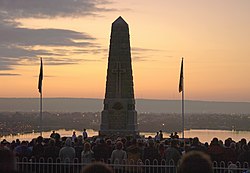
Today is ANZAC Day--a day in which we celebrate the achievements of the Australian and New Zealand Army Corps, specifically those during the Battle of Gallipoli during World War One. It is worth noting some interesting trivia about the battle. Well, Wikipedia facts:
Later in November 1914, First Lord of the AdmiraltyWinston Churchill put forward his first plans for a naval attack on the Dardanelles, based at least in part on what turned out to be erroneous reports regarding Turkish troop strength, as prepared by Lieutenant...
Okay, blame the intelligence lieutenant. It would really be a shame if this lieutenant's name went down in history as the lieutenant who gave Churchill bad intelligence regarding the Gallipoli landing. There is absolutely nothing a lieutenant could do to redeem himself from that.
One of my fellow bloggers in Iraq, Boss Mongo, has commented on a number of personalities well-known in the counterinsurgency field. many of whom have proven to be quite eccentric characters.
Last month, Mongo commented on an article from Small Wars Journal which discussed the various character attributes of T.E. Lawrence, whom I've commented on a number of times before. (By the way, the author of that article is awesome) My fascination with his character goes back a number of years. I knew of Lawrence largely from his role as a recurring character in the Young Indiana Jones Chronicles (circa 1990), where he assumes the role of an archaeologist specializing in the Middle East. Years later, as a lieutenant in the 82nd Airborne Division, I attended the 3 1/2 hour long movie Lawrence of Arabia at, believe it or not, an art-house theater in Fayetteville, NC. Yeah, there actually is one of those theaters in downtown Fayetteville, believe it or not. Anyway, what struck me about the character is that he, like I was at the time, was a bored lieutenant on someone's staff--over-educated and under-employed; he had a far greater sense of Middle Eastern politics and military strategy than his peers, and he was stuck with a mundane job. In his case, his job was to re-draw maps for briefings (which, in today's terms, would probably be akin to making PowerPoint slides).
Well, Mongo has introduced us to a new personality for all of us in the counter-insurgency/hybrid/4GW/pentathlete camp: a British intelligence officer named Orde Wingate. Mongo links to a book on Amazon about him (which, unfortunately, is not in Kindle format, so there's yet another book to lug around Iraq). Wingate had fought against the Arabs in Palestine, and had fought the Italians in Ethiopia alongside a brilliant strategist named Halie Selassie, a man who would gain future fame under the name "Ras Tafari". (Halie Sshould be no stranger to those who read The 48 Laws of Power and The 33 Strategies of War). He designed unconventional campaigns to prevent the Japanese from taking India and guerilla campaigns in Burma.
Now with brilliance comes a certain level of eccentricity. Lawrence had his peculiarities, but Wingate has him beat hands down. One tale described Wingate lying on his cot naked, combing his body hair with a toothbrush. Which, of course, is strange to us in the year 2009 because we've all discovered the art of manscaping. (Yes, admit it)
So thanks to Mongo, I have yet another book in my reading cache. I swear, I haven't been able to catch up on all the reading I want to do here. Looks like I'm going to have to finish off a few books when I take my mid-tour leave in a month or two.
Focus: We've discussed Lawrence and now Orde Wingate as leadership vignettes for counter-insurgents and "pentathlete warriors". Who else would you suggest as a pentathlete soldier?
Well, the challenge has been laid forth. A lieutenant colonel who goes by the moniker of "Boss Mongo" has challenged someone to write about "compound warfare"--a simultaneous use of conventional and unconventional forces. It's a phenomemon seen during the Southeast theater of the First World War, where T.E. Lawrence (controlling an Arab insurgency) and General Edmund Allenby (controlling maneuver forces, which were predecessors of the German blitzkreig forces) were able to drive back the Turkish forces. Indeed, the use of both insurgent and conventional forces would actually make up much of Maoist doctrine on revolutionary conflict.
I'm actually going to kick this one up a notch and look at "compound warfare", and also "hybrid warfare"--a blending of conventional and unconventional tactics to create a new, more deadly phase of conflict, which proved quite effective in the hands of Hezbollah forces in 2006, inflicting losses on an Israeli army who first tried counterinsurgency, then conventional tactics. I'm thinking of writing a basic primer on the subject and hoping someone who is not only bright but also with access to a much larger library and free time is able to finish it.
Two articles on hybrid warfare in the past two days from Small Wars Journal:
About a year and a half ago, I read T.E. Lawrence's Seven Pillars of Wisdom, and was captivated by it--the book gives amazing insight into the modern-day Iraq War and its participants--which I've already noted in an article I submitted to Small Wars Journal. From Lawrence and General Allenby's unconventional views on war, to the overly-conventional views of the mainstream British leadership, to the inability of the Turks to deal with an Arab insurgency, to Lawrence's planting of IEDs along the railways of Hejaz, the book is describes a situation eerily similar to our current conflict.
Unfortunately, like many great works, some have been guilty of taking Lawrence's views on war well out of context. Most notably is a line he uses in one of his works advising British service members on how to advise the Arabs during their insurgency, which Lawrence says:
“Do not try to do too much with your own hands. Better the Arabs do it tolerably than that you do it perfectly. It is their war, and you are to help them, not to win it for them.
In The War Within, written by journalist Bob Woodward, General George Casey misattributes this quote to Seven Pillars of Wisdom. He also takes the quote out of context and completely misapplies it--the Iraqi government was not operating tolerably in the days prior to the Surge.
Fortunately, Lt. Col. Robert Bateman assists us in placing the story in context, and even provides a little humor on the subject of the book. If you've ever wondered why "Lawrence of Arabia" goes on for four hours and includes several hours' worth of epic shots of Lawrence simply riding through the desert on a camel, you'll find it amusing that the book is little different at times. Only Lawrence could describe himself riding along on a camel through a featureless desert for pages on end.
But with that said, I highly recommend reading the entire book, as it's probably one of the best books I've read not simply for the military strategy involved, but also as a historical framework for the Middle East. Plus, it's a marvelous adventure.
One of my favorite books is From Russia, With Love by Ian Fleming.In that particular adventure of ultra-suave British secret agent James Bond, we find 007 traveling to Istanbul to steal a Russian decoding machine.He teams up with a Turkish agent in the employ of the British named Darko Kerim Bey.In his first meeting with Darko Kerim, Ian Fleming painstakingly describes the cup of Turkish coffee that Kerim Bey and 007 and Bond share.Being a coffee lover, I’d always kind of wondered if Turkish coffee was as rich, sweet and strong as Fleming described.
Ten years after reading From Russia, With Love, I wasn’t disappointed.
One of my many additional duties, in addition to flying and blogging, is to initiate various construction projects throughout our area. Lately, the United States has been depending on local Iraqi contractors and businesses, in an effort to attract Iraqi expatriates to settle back in Iraq and resume their businesses.The influx of businesses should revitalize the dilapidated economic infrastructure of the country, and improve at least the economic security situation of the country.Insurgencies prey on those with no other economic options, especially the ones in Iraq, which are fond of offering $20 USD, a considerable sum for Iraqis, to plant roadside bombs.Those with prospective economic security, however, suddenly have something to lose if they join the insurgencies.In a very real sense, the prospect of a real job attracted people towards legitimate business and away from the business of planting bombs.
With that said, we’re currently in the market to build a CrossfitGym, and I figured that consulting a local Iraqi construction firm located on the base might be a good first step.I had previously made contact with and received a business card from this particular company's team chif. I noted that his name wasn’t Arabic, but rather, Turkish.I remembered to study up on Turkish greetings before I went into the yard, lest I commit a social faux pas by greeting him in the Arab way.Walking in to the building, I noted that a number of icons were actually dedicated to Paul of Tarsus, the original apostle who hailed from a region in Turkey, and that the local newspapers were printed with Latin characters instead of Arabic, further confirming my belief that the men were, in fact, Turks.
I entered the team chief’s office and greeted him with the Turkish title "effendi", roughly meaning "sir", and we sat down for business.After exchanging pleasantries, I explained to him my situation and gave him specifications for the gym we wanted to build. Roughly eighty feet wide by fifty feet high.Of course, we would want power and air conditioning to compete with the 130F Iraqi summers. We had initially wanted a fifteen foot rope inside the building for climbing, but as the chief and I discussed this, we dismissed the idea, based on the viability of the support structures of the building, and rather settled for a rope hung from a beam outside.
With the crux of the matter done, he explained that it would take a day to do some calculations and then come up with an estimate.At that point, we were joined by two of his collegues, who asked if I would like to join them for Turkish coffee.Remembering the description of the Turkish coffee in Ian Fleming’s masterful novel, and being the coffee glutton I am, I eagerly agreed, noting that I had heard about the merits of Turkish coffee in From Russia With Love, explaining that it took place in Istanbul.
“Have you been to Istanbul?”, asked one of the men, a burly fellow with blue-grey eyes who did not look in the least bit Arabic, but rather Kurdish perhaps?
“No, but I have seen pictures…the Saint Sophia Mosque is very beautiful, one of the wonders of the world”, I replied.
“A very beautiful city” said the man, “In some places Istanbul has remained the same for six hundred years.”
“Well, except for the name, my friend” I quipped, eliciting some laughter from the men.
I asked for the man's name and explained that his name was Sulemein, a common name in the Middle East.
“As in 'Sulemein the Magnificent'”, I asked, referring to the great Ottoman Emperor.
“You know your history well”, he replied.He explained that he was from Irbil in Iraq, which is part of Kurdistan.Another gentleman, an Iraqi expatriate to Sweden, was originally from Suleimaniya, also in Kurdistan, near the Iranian border.
While the men might have lived in Turkey, it was now apparent they were Iraqi and Turkish Kurds—the third man was born in Turkey and later moved to Irbil in Kurdistan.
They explained that they were part of a construction company hired by the Americans after the 2003 invasion of Iraq.Their claim to fame was that they had developed the T-barrier, a concrete structure ubiquitous to Iraq.Baghdad and most major cities are ringed with thousands of these barriers.During General David Petraeus’ first day as the commander of American forces in Iraq, he walked the streets of Baghdad and ordered that hundreds of the T-barriers be emplaced around the buildings to provide protection for the local Iraqis.By all accounts, this, along with many other efforts at securing the population, was highly successful.
One of the workers shows me a sales brochure for various cement construction projects they have been working on.The brochure notes various projects that “are built in our country, Kurdistan”.The brochure also features such interesting language, such as “Kurdistan and Iraq”, implying that the Kurds viewed the Kurdistan as being completely seperate from Iraq.
With Kurdistan having its own flag, governing body, and having operated autonomously for almost thirty years, it is easy to see how might actually consider themselves to be their own independent nation.
By this time, one of the workers had brought out cups of Turkish coffee for all of us.While drinking coffee is popular the world over, in the Middle East, it is almost a ritual.T.E. Lawrence, the famous “Lawrence of Arabia”, noted in his famous account of the Arab Revolt against the Ottoman Turks during World War One, Seven Pillars of Wisdom, that the local Bedouin were “gluttons for coffee”.He writes of the Bedouin tribesmen stopping during the middle of the day to drink coffee even while crossing the scorching Nefudh Desert, a desert thought to be impassible even by Bedouin standards.
Turkish coffee is served in a small cup scarsely larger than a thimble.Thick, rich and strong, you don’t even sip the coffee, so much as you touch the cup to your lips and lick a tiny drop at a time.
The chief explained to me that he moved from Turkey to Irbil to go to a university to study civil engineering, and Suleiman adds that Iraqis are among the most well-educated of the Arabs.I asked if it was true that there was now an American University in Kurdistan (Irbil), to which they all replied that yes, the American University in Kurdistan had been open for a few years now, and was quickly expanding.
They then decided to drop the bomb on me, “Do you think American troops will really withdraw by the end of 2011”, one of them asked, referring to the recently-signed Status of Forces Agreement between the US and the Iraqi government.
To be honest, I wasn’t certain.Although the prospect of a troop withdrawal according to the timetable seems realistic, the Iraq War has been a conflict filled with unexpected twists and turns, with the dramatic improvement in security being the most recent.However, the withdrawal of forces from Iraq and the proposed “surge” in Afghanistan, which I could not see as entailing more than three or four brigades, seemed to largely fit with what I believed President-Elect Obama’s immediate military strategy seemed to be.
We discussed the complex demographics of Afghanistan.I thought it was difficult enough as it was to learn a few Arabic words to prepare for duty among the three major ethnic groups in Iraq, but in Afghanistan, there are some 400 ethnic groups and tribes, speaking any one of almost a dozen languages, from Uzbek, Farsi, Dari and Pashtu. Add the complex demographics to the isolated, mountainous terrain and throw in a booming opium trade to finance an insurgency, and you have a far different surge than the surge in Iraq.
With the bomb dropped on me, it was time to drop the bomb on them.
“What do you think will happen to Kurdistan in the next fifty years?Do you think it will be its own independent nation?”
A chuckle that emerged from the group. The chief paused for a second, choosing his words with care, “We know it is better to be part of Iraq than separate”.
“Besides", the Sweedish ex-patriate added, "We Kurds practically own Iraq”.
A bold claim? Possibly, but only just so.The men noted that Iraqi president Jalal Al-Talabani is Kurdish, as well as many well-placed advisors within the Maliki government. But only time will tell whether or not that will exist through the next round of elections.
I had reached the end of my coffee. I looked at the bottom of the cup and noticed that there was a thick layer of sludge. I asked if I should try to drink the sludge.
The chief stopped me.He demonstrated turning his cup upside down on the saucer, letting the sludge ooze out from underneath the cup onto the saucer.He explained that an old custom is to read one’s fortune in the sludge at the bottom of a cup of Turkish coffee.He jokeed that hopefully, the cup of coffee will tell me which way I turn to return to my portion of the FOB. I hope it does, as the FOB is a large place and it's easy to get lost.
I followed suit, waited a few seconds and turned my cup back over. Showing him the remaining coffee grinds in my cup, I asked him what my future held.
The chief looked at the cup carefully, as if studying it intently, for a few seconds.Finally, he smiled and slapped me on the back.
“My friend, this tells me that you will be here for a year”